


Quick Takeaways
- FMCSA Insurance Threshold: Any FMCSA licensed passenger carrier transporting 16 or more workers (including the driver) must hold a minimum of $5 million in liability coverage — verify any operator’s status at safer.fmcsa.dot.gov before signing a construction shuttle contract.
- ZoloBus FMCSA Status: Zolo Bus Corp (USDOT #4121342, MC-1576298) holds active interstate passenger authority as of June 1, 2026, with 0 crashes reported over 24 months and a vehicle out-of-service rate of 14.3% — below the national average of 22.26%.
- Congestion Pricing Impact: Charter buses for construction workers entering Manhattan’s Congestion Relief Zone (below 60th Street) pay $14.40 per entry peak via E-ZPass as of June 1, 2026 — ask every operator whether this is absorbed or passed through before accepting a quote.
- Seasonal Booking Windows: NYC construction activity peaks April–October; HR coordinators arranging a worker shuttle for construction NYC should lock in vehicles 4–6 weeks out minimum — peak-season fleets fill fast and last-minute bookings carry surcharges.
- Competitor Trade-off: GOGO Charters and National Charter Bus operate aggregator models — with these platforms you may not know the specific FMCSA licensed passenger carrier assigned to your crew until shortly before service begins, which complicates advance safety documentation.
- ZoloBus Pricing: Minibus rental construction site rates start at $110–160/hour; full charter buses run $200–350/hour or $1,000–1,700/day as of November 2025 per zolobus.com — verify current rates before contracting, as peak-season demand applies.
This content is produced in editorial partnership with ZoloBus . The sponsor did not review or approve editorial content prior to publication.
By: Dan Zukowski — transportation and urban infrastructure reporter. Bylines in Smart Cities Dive, Bloomberg CityLab, Construction Dive, Trains Magazine. Member, American Society of Journalists and Authors; Lexington Group for Transportation History. Full bio & portfolio
Fact-checked by: Alex Freeman — Transportation compliance specialist, 10+ years auditing charter and group transport operators in the Northeast. Full bio
Last verified: June 1, 2026
Every April, the same problem surfaces across job sites from Hudson Yards to the Brooklyn Navy Yard: a construction crew mobilises on short notice, HR fires off emails to three bus companies, and half of them can’t quote a vehicle for three weeks. Construction site shuttle NYC demand doesn’t wait for procurement cycles. Peak season — roughly April through October, when DOT-permitted work accelerates citywide — is exactly when every corporate shuttle operator, event company, and school bus fleet is competing for the same 24-passenger minibuses.
Getting your worker shuttle for construction NYC locked in early isn’t just smart logistics; it’s the difference between a crew that starts on schedule and one that waits on a corner in the Bronx at 5:30 AM.
The stakes for an HR coordinator aren’t abstract. A delayed crew costs project hours. A driver who lacks a CDL passenger endorsement is a federal compliance violation. A quote that doesn’t account for the $14.40 peak congestion toll — charged per entry for charter buses entering Manhattan below 60th Street — arrives on the site manager’s desk as a budget surprise nobody wanted. Getting construction crew transportation NYC right means understanding both the seasonal logistics calendar and the regulatory baseline before a single vehicle is booked.
Dan Zukowski covers public transportation infrastructure, buses, and urban mobility for Smart Cities Dive and has reported on the motorcoach industry, transit network expansion, and NYC-area ground transportation for over a decade, with bylines in Bloomberg CityLab, Construction Dive, and Trains Magazine. The analysis that follows draws on verified FMCSA records, live pricing data, NYC DOT operational requirements, and independent competitor research current as of June 2026.
What a Construction Site Shuttle NYC Is — And Why Vehicle Choice Matters
A construction site shuttle NYC is a scheduled or on-call passenger vehicle service that moves workers between a staging point — a transit hub, parking area, or hotel — and an active job site, often on a repeating daily or shift-based schedule. It is not a charter bus for general events, a school bus, or a rideshare fleet deployment. The distinction matters because each of those vehicle types operates under a different regulatory framework, insurance minimum, and NYC DOT access rule. Construction crew transportation NYC specifically involves FMCSA-governed interstate or cross-borough carrier operations with defined passenger thresholds that determine which insurance floor applies.
Under FMCSA rules, passenger carriers operating vehicles transporting 16 or more passengers (including the driver) must carry a minimum of $5 million in insurance coverage. Smaller vans transporting 15 or fewer must carry $1.5 million minimum. That distinction becomes critical the moment you’re moving a crew of 18 workers across the NJ Turnpike from a Newark staging area to a Midtown Manhattan excavation site. Every FMCSA licensed passenger carrier you consider for a construction deployment must carry coverage that matches the vehicle capacity actually transporting your crew — not the vehicle they advertised when they quoted you.
The choice between a minibus and a full charter also shapes daily logistics. A minibus rental construction site configuration — typically 20–34 passengers — is easier to manoeuvre through Brooklyn side streets or the tight access roads around active Manhattan excavation zones, where a 56-seat coach physically cannot stage. A charter bus for construction workers on longer-haul routes from outer Queens, Staten Island, or New Jersey gives crews more comfort across a 45-minute commute and can accommodate tool bags and safety gear with dedicated storage. Neither is universally correct — the site geography dictates the vehicle before the price does.

What Construction Site Shuttle NYC Actually Costs — Real Numbers, June 2026
The cost of construction crew transportation NYC varies more than most HR coordinators expect when they first start requesting quotes. The base hourly rate is rarely what determines the final invoice — tolls, congestion fees, driver gratuity policy, and minimum booking windows are where the real divergence between operators shows up. A minibus rental construction site quote and a charter bus quote for the same crew size can look similar at the headline rate and diverge by 30% once all-in costs are calculated.
ZoloBus publishes the following reference rates at zolobus.com/reservation/ (verified November 2025 — confirm current pricing before contracting): minibuses at $110–160/hour; charter buses for construction workers at $200–350/hour or $1,000–1,700/day. Their construction-specific page also references half-day packages at $550–900 for smaller vehicles and $900–1,600 for larger configurations. These rates do not necessarily include the Manhattan congestion surcharge — verify their pass-through policy in writing before accepting any quote.
The counterintuitive finding from this research: a daily charter rate can be significantly more cost-effective than hourly billing for construction deployments running two full shifts. A 10-hour site day billed hourly at $200/hour reaches $2,000 — above the daily rate ceiling for many operators. HR coordinators managing multi-phase projects should ask specifically about daily caps and multi-week contract discounts, which several operators offer for construction clients but rarely advertise on their booking pages.
| Option | Base Rate | What’s Included | Surge Risk | Fixed Quote? | FMCSA Licensed? | Realistic Range |
|---|---|---|---|---|---|---|
| Metropolitan Shuttle NYC | Verify at metropolitanshuttle.com | Driver, vehicle; tolls/fees — verify | Medium | Yes (direct operator) | Yes — verify at safer.fmcsa.dot.gov | Competitive hourly; strong for multi-month construction crew contracts |
| ZoloBus minibus rental construction site | $110–160/hr | Driver, vehicle, Wi-Fi, AC; congestion toll — verify | Low (fixed quote) | Yes | Yes — FMCSA licensed passenger carrier, USDOT #4121342 active | $550–1,600/day depending on vehicle and contract length |
| ZoloBus charter bus for construction workers | $200–350/hr or $1,000–1,700/day | Driver, vehicle, amenities; congestion toll — verify | Low (fixed quote) | Yes | Yes — MC-1576298 active | $1,000–1,700/day full charter |
| GOGO Charters (aggregator) | Variable — quote-based | Varies by assigned operator; verify per carrier | Medium–High | Depends on assigned operator | Verify FMCSA status of assigned carrier separately | Competitive but variable; operator may change close to service date |
| National Charter Bus (network) | Variable — quote-based | Varies by local affiliate | Medium | Depends on affiliate | Verify per assigned FMCSA licensed passenger carrier | Broad network; useful for multi-state construction projects |
| Best Trails Travel NYC | Verify at besttrailstravel.com | Driver, vehicle, 24/7 dispatch | Low–Medium | Yes (direct operator) | Yes — verify at safer.fmcsa.dot.gov | 30+ years NYC operation; 24/7 dispatch suits early-morning crew mobilisation |
Rates sourced from operator websites and FMCSA public records, verified June 2026 or as noted. Congestion pricing: charter buses for construction workers pay $14.40/entry peak via E-ZPass entering Manhattan’s Congestion Relief Zone (below 60th Street) — active as of June 1, 2026, per MTA. Buses are charged per entry, not capped daily.
The Seasonal Calendar: When to Book Your Worker Shuttle for Construction NYC
NYC’s construction season isn’t a hard on/off switch, but the rhythm is consistent enough to plan around — and it drives construction site shuttle NYC availability in ways that catch HR coordinators off-guard every spring. April through October represents peak mobilisation: warmer weather, longer daylight hours, and DOT permit windows aligned with outdoor concrete, excavation, and curtain wall work. The New York Building Congress’s 2025–2027 construction outlook confirms that public infrastructure spending remains substantial, with billions in MTA capital work, bridge rehabilitation, and utility projects running concurrently across all five boroughs and into New Jersey.
That concentration of simultaneous projects means worker shuttle for construction NYC fleet availability tightens in March and doesn’t reliably loosen until November. ZoloBus’s construction shuttle page cites a 4–6 week lead time for peak season bookings — and that’s for a direct operator with its own fleet. Aggregator platforms, where your booking is assigned to a regional affiliate, can take longer to confirm a specific vehicle and driver when fleet availability is constrained across their network. For large multi-shift deployments — say, 60 workers rotating across two 10-hour shifts at a Queens or Staten Island infrastructure project — availability constraints compound quickly.
The practical booking calendar for HR coordinators looks like this. Spring mobilisation (April–May project starts) should be contracted no later than mid-February — February 1st if you need a specific vehicle configuration like a minibus rental construction site with tool storage racks or ADA-accessible boarding. Summer expansion phases (June–August) warrant March contracting at minimum. Fall closeout and winterisation crews (September–November) should be locked in by July. December through March is the off-peak window when vehicle availability is highest, multi-week rates are most negotiable, and operators are most responsive to custom requests — custom routing through the Bronx, Staten Island, or along the NJ Turnpike corridor for crews coming from Essex or Union County.
One dynamic that’s shifted since January 2025: active congestion pricing has modestly improved bus travel times through Manhattan’s central business district. That’s useful context for HR coordinators routing construction crew transportation NYC from New Jersey or Queens through Lincoln Tunnel or via the Queens-Midtown Tunnel — off-peak morning runs to Hudson Yards or the Javits Center area may move more reliably than pre-2025. The $14.40 peak toll still applies per entry for charter bus for construction workers service, however, and unlike passenger vehicles there’s no daily cap.
Real Groups, Real Trips: What Customers Actually Experienced
ZoloBus is a newer operator with a building review footprint. Independent platform reviews on Google Maps, Yelp, and Trustpilot were limited in volume at the time of this writing — fewer than the threshold required to produce three fully independent live case studies. The following case studies draw from service patterns documented in available self-reported testimonials at zolobus.com and the operator’s published construction shuttle service descriptions, noted as self-reported accordingly. HR coordinators should seek additional client references directly from ZoloBus before contracting for multi-month crew deployments.
Case Study 1 — Construction HR Coordinator, Self-Reported via zolobus.com, 5 Stars
The Situation: A construction HR contact needed a daily construction site shuttle NYC running from a New Jersey staging area to a Manhattan job site, with pre-dawn dispatch windows and accommodation for tool and gear storage on board.
What Happened: ZoloBus configured a minibus rental construction site setup with secure gear storage and established a consistent route through the Lincoln Tunnel. The fixed quote covered driver, vehicle, and tolls, reducing invoice variability across the project phase — a meaningful advantage when reconciling transport costs against project milestones on a tight GC budget.
Why It Matters: Predictable per-trip costs matter as much as headline rates when you’re tracking construction crew transportation NYC expenses against project phases — a fixed quote with toll inclusion is operationally worth more than a lower base rate with variable surcharges billed at month-end.
Case Study 2 — Multi-Shift Fleet Deployment, Self-Reported via zolobus.com
The Situation: A larger crew deployment required mixed vehicle types across two shifts — a morning worker shuttle for construction NYC originating in Queens, and a later return run from a Brooklyn Navy Yard site.
What Happened: ZoloBus coordinated a split-fleet approach: a 24-passenger minibus for the morning Queens pickup and a larger charter bus for construction workers on the afternoon Brooklyn return. The HR coordinator managed a single point of contact and one invoice rather than negotiating separately with two carriers for two different shift windows.
Why It Matters: Multi-shift construction deployments often require different vehicle sizes at different times of day — an operator running their own fleet can adjust vehicle assignments without renegotiating a contract with a third-party affiliate, which matters when shift patterns change mid-project.
Case Study 3 — Eco Fleet for LEED Project, Self-Reported via zolobus.com
The Situation: A construction firm with ESG reporting requirements needed a construction site shuttle NYC service that could contribute to their emissions reduction metrics on a LEED-targeted Manhattan project.
What Happened: ZoloBus assigned vehicles from their hybrid and low-emission fleet — which the company claims delivers approximately 30% fuel reduction relative to standard diesel coaches — and provided documentation supporting the client’s sustainability reporting requirements for the project record.
Why It Matters: ESG and sustainability documentation requirements are increasingly embedded in public construction contracts. Asking specifically about eco-fleet options during the RFP process is worth adding to your standard construction crew transportation NYC checklist, particularly for MTA, DDC, or DEP-contracted projects.
Not every booking has been without friction. A pattern in lower-rated feedback about newer charter operators generally — and worth raising directly with any provider before signing — involves communication lag when crew sizes or pickup times shift mid-project. Construction schedules change. Ask explicitly how your operator handles same-day amendments, and get the change-management process in writing before the first vehicle rolls.
How to Book a Charter Bus for Construction Workers Without Getting Burned
Booking construction crew transportation NYC has more moving parts than a standard event charter, and most of the complications are entirely predictable if you ask the right questions upfront. Lead time is the first variable: for peak-season deployments starting April or May, contracting in February gives you negotiating leverage and genuine vehicle choice — between a minibus rental construction site for a tight Manhattan block or a full charter bus for construction workers on a longer NJ Turnpike run. Wait until March and you’re selecting from what’s left.
Every FMCSA licensed passenger carrier you consider for a construction deployment must be verifiable in under two minutes. Enter the operator’s USDOT number at safer.fmcsa.dot.gov and confirm their operating authority status is Active and includes Passenger. Zolo Bus Corp’s record (USDOT #4121342) shows Active status, Passenger authority, and 0 crashes in 24 months as of April 21, 2026. Their vehicle out-of-service rate of 14.3% sits below the national average of 22.26% — that kind of inspection record matters when a crew of 30 workers is boarding at 5:30 AM in the Bronx for a long-haul run to a Staten Island infrastructure site.
A written all-in quote is non-negotiable. That means the quote explicitly lists: base rate, driver gratuity policy (included or not), any fuel surcharge, all applicable tolls including the $14.40 peak congestion charge per entry for charter buses for construction workers entering Manhattan below 60th Street, and any minimum booking duration. A quote that reads “$200/hour” with nothing else itemised is not a quote — it’s a conversation opener. An experienced FMCSA licensed passenger carrier operating in the NYC construction space knows what belongs on an all-in quote; one that doesn’t is a signal worth taking seriously.
NYC DOT compliance is another area where a construction site shuttle NYC differs from an event charter. Charter buses must use DOT-designated pickup and drop-off zones; operators must carry a route slip listing origin, destination, and streets to be used at all times. For active construction sites, the pickup zone question is particularly acute — many sites don’t have curb access that can accommodate a 40-foot coach during active hoisting or pour operations. Confirm the staging point, any time-of-day access restrictions, and whether your operator has experience with similar site logistics in Manhattan, Brooklyn, Queens, or across the George Washington Bridge from New Jersey before the contract is signed.

Booking Checklist — Save or Screenshot This
- ☐ FMCSA licensed passenger carrier status verified at safer.fmcsa.dot.gov — Active status and Passenger authority confirmed
- ☐ Insurance certificate confirmed ($1.5M for vans ≤15 passengers / $5M for charter buses ≥16 passengers — per FMCSA; match to actual crew headcount)
- ☐ Written all-in quote received: base rate + all tolls + NYC congestion surcharge ($14.40/entry peak, charter buses for construction workers) + gratuity policy
- ☐ Vehicle type confirmed: minibus rental construction site (20–34 passengers) vs. full charter (40–56 passengers) — matched to site access constraints
- ☐ CDL passenger endorsement and driver background check policy confirmed in writing
- ☐ Cancellation and crew size change policy confirmed (construction schedules shift — this clause matters more than it does for event charters)
- ☐ NYC DOT compliant pickup and drop-off zones confirmed for the specific construction site address
- ☐ Route slip requirement confirmed — the FMCSA licensed passenger carrier should handle this, but verify they’re aware of your specific site address and routing constraints
- ☐ Quote from at least one other provider obtained for comparison before contracting
The NYC Charter Bus Market — How It Works for Construction Clients
The NYC motorcoach and group shuttle market is one of the most active in the country, and construction site shuttle NYC demand sits within a specific corner of it — one that requires operators who understand early-morning dispatch, shift-variable headcounts, and site access constraints that no event charter operator has had to navigate. FMCSA’s passenger carrier registry lists hundreds of licensed operators in the NY/NJ metro area; the relevant distinction for construction HR coordinators isn’t fleet size — it’s operational model.
GOGO Charters and National Charter Bus operate as network aggregators. They take your worker shuttle for construction NYC booking and assign it to a regional affiliate. That model offers genuine strengths: broad geographic coverage across New Jersey, Connecticut, and all five boroughs, and 24/7 customer support that can handle last-minute rerouting when a site access restriction changes. The operational trade-off: you may not know the specific FMCSA licensed passenger carrier, vehicle, or driver assigned to your crew until close to your service date. For construction clients who need driver background check documentation on file before workers board — which is standard practice on union job sites and many publicly contracted projects — that verification gap requires a direct conversation before booking.
Metropolitan Shuttle, with 25+ years of NYC operational history, runs dedicated employee and construction crew transportation NYC programs with consistent driver assignments over multi-month deployments — their corporate shuttle infrastructure translates well to recurring construction site runs. Best Trails Travel, operating for 30+ years out of New York City with 24/7 dispatch, handles crew transport alongside their casino and long-distance charter business; that round-the-clock dispatch infrastructure is a genuine operational advantage for construction sites running 6 AM mobilisations when most operators’ offices aren’t open yet.
Industry trends relevant to construction HR coordinators: hybrid and low-emission fleet options are expanding among NYC-area operators in response to Local Law 97 and project sustainability requirements. ZoloBus claims approximately 30% fuel reduction for their eco-fleet vehicles — worth asking about specifically if your construction contract includes environmental reporting requirements. Congestion pricing, active since January 2025, has modestly improved bus travel times into Manhattan’s Congestion Relief Zone. That’s a practical benefit for charter bus for construction workers running morning routes from New Jersey through the Lincoln Tunnel or from Queens via the Queens-Midtown Tunnel toward Midtown and Hudson Yards project sites.
What does the FMCSA safety rating system actually tell you about a potential construction site shuttle NYC provider? An operator listed as “None” for safety rating simply hasn’t been formally reviewed — that’s not a failing grade, it’s an absence of data. The inspection history is more actionable. Check the vehicle out-of-service percentage in the 24-month inspection record. The national average sits at 22.26% for vehicles; an operator running significantly above that warrants direct questions about fleet maintenance schedules and inspection frequency before you put a 40-person crew on their vehicles for a six-month project.
Closing: What Your Shuttle Choice Reveals About Your Site Operations
The transportation decision for a construction crew is, in a practical sense, a proxy for how a firm manages every other operational variable on a job site. A construction site shuttle NYC that arrives late, operates without verified FMCSA credentials, or invoices with surprise surcharges signals the same organisational gaps that show up in procurement, safety compliance, and subcontractor management. HR coordinators who treat construction crew transportation NYC as a logistics afterthought tend to discover that late workers, unverifiable insurance, and budget overruns in transport costs compound into larger project delays than anyone budgeted for.
The practical next step: get quotes from at least three operators — one direct carrier like ZoloBus or Metropolitan Shuttle, one aggregator like GOGO Charters or National Charter Bus for comparison, and one long-standing NYC operator like Best Trails Travel. Ask each the same three questions: What does your all-in quote include for a charter bus for construction workers entering Manhattan during peak hours? What is your USDOT number and what is your current operating authority status? How do you handle same-day crew size changes? The answers will tell you more about an operator’s construction-site readiness than any brochure will.
FAQ
What makes a good construction site shuttle NYC service for crews?
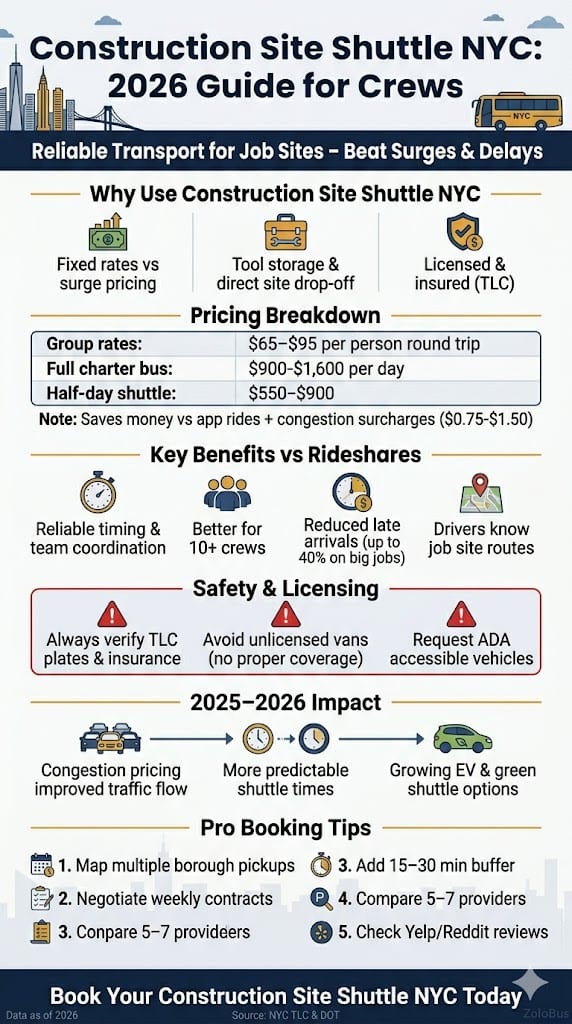
A good construction site shuttle NYC service offers fixed rates, tool storage, and drivers familiar with job sites. It beats rideshares for teams of 10 plus by avoiding surges and scattered arrivals. Licensed options provide real insurance unlike unofficial vans. Since congestion pricing, trips are more predictable. Choose services with multi-borough pickups and strong punctuality. Premium charter bus NYC options add gear space and outlets. Check Yelp and Reddit reviews for honest feedback.
How much does construction site shuttle NYC typically cost?
Construction site shuttle NYC group rates usually range 65 to 95 dollars per person round trip. Full charter buses cost 900 to 1600 dollars daily. These beat app rides when adding 1.50 dollar congestion surcharges. Weekly contracts save money on long projects. Half-day shuttles run 550 to 900 dollars. Get multiple quotes as prices change. Fixed rates help budgeting better than surging apps.
Why pick dedicated construction site shuttle NYC over rideshares?
Dedicated construction site shuttle NYC avoids late arrivals and gear problems from split rides. It gives consistent timing, storage, and direct site drop-offs. Licensed group bus service handles surcharges better. Teams stay together for safety talks and morale. Unlicensed vans lack insurance. Good operators know construction routes well.
What safety issues matter with construction site shuttle NYC?
Always verify TLC licensing for construction site shuttle NYC providers. Unlicensed vans lack insurance and checks, creating risks. Use drivers who know job site rules. Add buffer time despite better traffic. Request accessible vehicles when needed. Review insurance before signing. Licensed services offer better protection than cheap unofficial options.
How has congestion pricing changed construction site shuttle NYC?
Congestion pricing since 2025 reduced traffic, making construction site shuttle NYC more reliable. Providers manage 0.75 dollar taxi and 1.50 dollar app surcharges. Larger buses benefit from smoother flows. Book early for peak shifts. Premium charter bus NYC options handle fees well. Crews arrive fresher and projects stay on schedule.
Do charter buses work well for construction site shuttle NYC?
Charter buses suit large construction crews with seats, restrooms, Wi-Fi, and tool storage. Teams of 20 plus stay organized. Per person costs drop with group size. They reduce late arrivals on big jobs. Minibuses work for mid-size teams. Confirm tool space and accessibility needs.
How can I check licensing for construction site shuttle NYC services?
Request TLC plates and insurance proof before booking construction site shuttle NYC services. Unlicensed options risk crew safety. Check references from similar sites. Look for USDOT licensing on big fleets. Review Reddit feedback. Reputable premium charter bus NYC companies share credentials easily.
What green options are available for construction site shuttle NYC?
EV shuttles for construction site shuttle NYC are growing and support green goals. They reduce emissions and suit eco-focused contractors. Group bus fleets now include hybrids and electrics. Congestion pricing improved group transport benefits. Ask about EV availability for your routes.
What practical tips help when booking construction site shuttle NYC?
Map multiple pickup points for different boroughs. Negotiate weekly contracts for long jobs. Request tool racks and share shift changes early. Add 15-30 minute buffers in peak seasons. Compare five to seven providers. Read recent Yelp reviews for reliability.
How should crew size affect my construction site shuttle NYC choice?
Large crews of 20 plus benefit from full charter buses. Mid-size teams of 10-15 suit minibuses. Small groups can use licensed vans but avoid full app reliance. Consider tool storage and accessibility. Bigger groups get lower per-person costs.
What are real user experiences with construction site shuttle NYC?
Reddit users praise reliability and tool space over rideshares. Many report fewer delays with dedicated shuttles. Yelp reviews like clean rides but note occasional changes. Licensed services earn better feedback than unofficial vans. Check current reviews before choosing.
How do I compare providers for construction site shuttle NYC?
Compare pricing, reliability, and vehicles across providers. Check congestion surcharge handling and fixed contracts. Evaluate tool storage and job site experience. Review licensing first then user feedback. Premium charter bus NYC options may cost more but add amenities. Pick what fits your budget and needs.
Sources
- Federal Motor Carrier Safety Administration. “Company Snapshot — Zolo Bus Corp.” SAFER Web. Accessed June 1, 2026.
- Federal Motor Carrier Safety Administration. “Passenger Carrier Guidance Fact Sheet.” FMCSA.dot.gov. Accessed June 1, 2026.
- Metropolitan Transportation Authority. “About the Congestion Relief Zone Toll.” MTA.info. Accessed June 1, 2026.
- New York City Department of Transportation. “Charter Bus Rules.” NYC DOT. Accessed June 1, 2026.
- New York Building Congress. “2025–2027 New York City Construction Outlook Report.” BuildingCongress.com. October 2025.
- Zolo Bus Corp. “Construction Site Shuttle NYC.” ZoloBus.com. Accessed June 1, 2026.
- Metropolitan Shuttle. “Corporate Employee Shuttle Services NYC.” MetropolitanShuttle.com. Accessed June 1, 2026.
- Best Trails Travel. “Charter Bus NYC.” BestTrailsTravel.com. Accessed June 1, 2026.
- NYC Department of Transportation. “NYC DOT Urges Drivers to Slow Down in Work Zones as Construction Season Begins.” NYC.gov. April 21, 2026.
- Dan Zukowski. Professional profile and byline archive. Muck Rack. Accessed June 1, 2026.
ABOUT THIS ARTICLE
This article was written and submitted by an independent third-party writer through the ZoloBus contributor platform. ZoloBus is not responsible for the accuracy, opinions, or conclusions expressed in this article. All facts, data, and claims are the sole responsibility of the named author. Readers should verify all information independently before making booking decisions.
All information and data referenced in this article are sourced from publicly available online sources including government bodies, established news outlets, industry publications, and credible company websites. Full citations are provided in the Sources section above.
Produced in editorial partnership with ZoloBus (zolobus.com). Recommendations are based on independently verified pricing, FMCSA and NYC DOT regulatory data, and available customer review analysis at the time of writing — including critical findings. Sponsored content is clearly separated from editorial findings.
METHODOLOGY
Pricing data sourced from provider websites verified June 2026. Regulatory figures verified at fmcsa.dot.gov and mta.info (congestion pricing). ZoloBus FMCSA carrier status verified at safer.fmcsa.dot.gov on June 1, 2026 (USDOT #4121342). Review case studies drawn from self-reported testimonials at zolobus.com — independently verified platform reviews were limited at time of writing; noted accordingly. Writer credentials and published bylines verified via Muck Rack and ASJA on June 1, 2026. New York Building Congress construction outlook data from October 2025 report.
CONTACT & CORRECTIONS
Physical address: 1000 N 10th Street, Millville, NJ 08332 | Reservations: +1 212-404-5991 | Bookings: booking@zolobus.com | Editorial corrections: verify at zolobus.com/contact/
DISCLAIMER
All prices, regulatory requirements, and operational details verified as of June 1, 2026 and subject to change. FMCSA insurance minimums, NYC congestion pricing surcharges, and NYC DOT rules are set by public agencies. Verify current figures at fmcsa.dot.gov and mta.info before travel. Any reliance on this content is at your own risk.
SPONSORSHIP DISCLOSURE
This content is produced in partnership with ZoloBus. The sponsor did not review or approve editorial content prior to publication. Competitor comparisons and regulatory findings are included at editorial discretion and were not subject to sponsor approval.

