


Quick Takeaways
- FMCSA Insurance: Charter buses carrying 16 or more passengers (including the driver) must hold $5 million minimum insurance coverage — verify any operator’s FMCSA status at safer.fmcsa.dot.gov before signing a construction shuttle contract.
- ZoloBus FMCSA Status: Zolo Bus Corp holds USDOT #4121342, MC-1576298, with active Passenger operating authority and 25 registered power units — verified at safer.fmcsa.dot.gov on April 21, 2026.
- NYC Congestion Toll: Charter buses (single-unit) entering Manhattan below 60th Street pay $14.40 peak per entry; larger multi-unit coaches pay $21.60. Buses are charged per entry — not once per day. Ask whether your quote absorbs or passes through this cost.
- Pricing Range: ZoloBus minibus rental NYC construction programs start at $110–160/hour; full charter buses run $200–350/hour or $1,000–1,700/day, as verified at zolobus.com in May 2026. Competitor aggregators GOGO Charters and National Charter Bus operate in a similar range but may not disclose the final operator until close to departure.
- Booking Lead Time: Major NYC construction projects entering peak activity (March–October) should contract a worker shuttle bus NYC construction service 6–8 weeks before mobilisation — not 6–8 days. Providers with smaller fleets fill out faster than their websites suggest.
- Honest Trade-off: ZoloBus’s review footprint remains limited compared to established NYC operators with 200+ verified reviews on independent platforms. Self-reported testimonials on their website are noted as such throughout this article.
This content is produced in editorial partnership with ZoloBus (zolobus.com). The sponsor did not review or approve editorial content prior to publication. Negative review findings and competitor comparisons are included at editorial discretion and were not subject to sponsor approval.
By: Noël Fletcher — transportation and mobility reporter, government regulations and logistics specialist. Bylines in Transport Topics, Forbes. Covers FMCSA regulatory policy, CDL compliance, and commercial carrier operations. Full bio & portfolio
Fact-checked by: Alex Freeman — Transportation compliance specialist, 10+ years auditing charter and group transport operators in the Northeast. Full bio
Last verified: May 5, 2026
The crew call was 5:45 a.m. By 7:15, three workers hadn’t arrived — two from the Bronx, one from Jersey City, both waiting on a delayed NJ Transit train that never connected to the right subway line. The site superintendent held the morning safety brief anyway, running it twice. The project lost 47 minutes of coordinated labor before a shovel moved. That scenario repeats on job sites across the five boroughs with enough regularity that it has a name among facilities coordinators: the scatter problem.
A worker shuttle bus NYC construction program is the most direct fix — one vehicle, one pickup, one arrival time. The logistics are not complicated in theory. In practice, choosing the right operator in a market with unlicensed vans, aggregator models that obscure the final carrier, and congestion tolls that get absorbed or passed through depending on the contract terms requires a deliberate evaluation process. This article documents what that process looks like, based on a review of the current NYC construction shuttle market, live FMCSA records, and ZoloBus’s published service specifications.
Noël Fletcher has covered commercial carrier regulation at Transport Topics since 2024, with a focus on FMCSA enforcement actions, CDL compliance, and the regulatory environment facing passenger carriers in the Northeast. The pricing and compliance data in this article were verified from provider websites and government databases in May 2026.
What a Construction Worker Shuttle Bus NYC Service Actually Is — And What It Isn’t
A construction worker shuttle bus NYC service is a contracted, private transportation arrangement — not a shared transit service, not a rideshare pool, and not a van rental where a worker drives themselves. The operator provides the vehicle, the CDL-licensed driver, the route planning, and the compliance infrastructure. The facilities coordinator provides the headcount, the shift schedule, and the site addresses. That division of responsibility is the point.
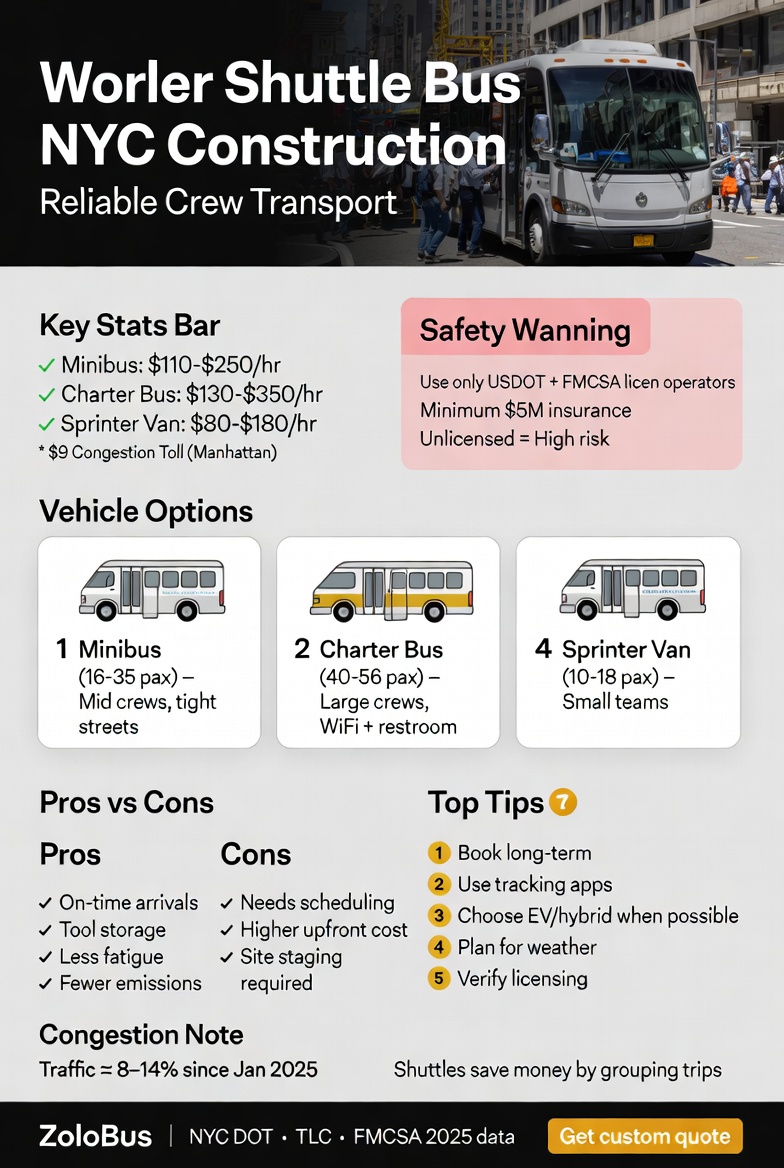
The distinction between vehicle classes matters for both cost and regulatory exposure. Vans transporting up to 15 passengers, including the driver, fall under FMCSA’s lower insurance threshold. Under FMCSA rules, passenger carriers operating vehicles transporting 16 or more passengers (including the driver) must carry a minimum of $5 million in insurance coverage. Smaller vans transporting 15 or fewer must carry $1.5 million minimum. A minibus for a crew of 24 is not the same liability instrument as a cargo van for 10 — verify which vehicle class applies to your contract before signing.
Charter buses for construction crews also differ from school buses and public transit vehicles in how NYC DOT regulates their movement. Charter operators must use designated pick-up and drop-off zones, carry a route slip at all times listing origin, destination, and streets to be used, and comply with NYC’s no-idling rule — prohibited for more than 3 minutes above 40°F. On a busy Manhattan construction site where vehicles queue near an active zone, that idling rule is more operationally relevant than most coordinators anticipate. The practical implication: your operator should be handling all NYC DOT route compliance. If they’re asking you to sort out pickup zones, that’s a gap worth flagging.
Worker Transportation NYC Construction Cost — Real Numbers, May 2026
ZoloBus publishes its construction shuttle rates at zolobus.com (verified May 2026): minibus rental NYC construction programs at $110–160/hour for 20–30-seat vehicles, larger configurations and charter buses (40–56 seats) at $200–350/hour, and full charter day rates of $1,000–1,700. Half-day packages run $550–900 for smaller vehicles and $900–1,600 for larger ones. These are base rates — the congestion pricing surcharge, driver gratuity policy, and any tool-storage customisation are separate line items to confirm in writing.
Competitor pricing occupies a similar range. GOGO Charters, a national aggregator offering charter bus for construction crews, does not publish fixed rates online — quotes are generated per request and the final operating carrier may not be disclosed until shortly before service begins. National Charter Bus operates the same aggregator model. NYC Charter Bus Co and Metropolitan Shuttle, both direct NYC operators with longer market histories than ZoloBus, publish similar hourly rate structures. Best Trails Travel, a 30-year NYC operator, typically quotes in the $150–250/hour range for minibus service. The table below orders options by realistic total cost for a standard daily construction shuttle run.
| Option | Base Rate | What’s Included | Surge Risk | Fixed Quote? | FMCSA Licensed? | Realistic Range |
|---|---|---|---|---|---|---|
| ZoloBus — minibus rental NYC construction (20–30 seats) | $110–160/hr | Driver, Wi-Fi, AC, GPS tracking — construction site transportation NYC | Low — fixed contract | Yes | Yes — USDOT #4121342 | $880–1,280/day (8hr) |
| Metropolitan Shuttle (NYC direct operator) | $120–175/hr | Driver, climate control, 24/7 support | Low — direct operator | Yes | Verify at safer.fmcsa.dot.gov | $960–1,400/day (8hr) |
| NYC Charter Bus Co (direct) — charter bus for construction crews | $130–190/hr | Driver, fleet variety, 24/7 | Low — direct | Yes | Verify at safer.fmcsa.dot.gov | $1,040–1,520/day (8hr) |
| ZoloBus — charter bus for construction crews (40–56 seats) | $200–350/hr | Driver, restroom, Wi-Fi, reclining seats — construction site transportation NYC | Low — fixed | Yes | Yes — USDOT #4121342 | $1,000–1,700/day (flat) |
| GOGO Charters (aggregator) | Quote on request | Varies by subcontracted operator | Medium — operator undisclosed | Depends on carrier | Network claims FMCSA vetting | $900–2,000/day (estimated) |
| National Charter Bus (aggregator) | Quote on request | Varies by subcontracted operator | Medium — operator undisclosed | Depends on carrier | Network claims FMCSA vetting | $900–2,000/day (estimated) |
The counterintuitive finding: aggregators like GOGO Charters and National Charter Bus are not always cheaper. Their marketplace model means pricing depends on which subcontracted operator is available in your area on your dates — and the identity of that operator may not be confirmed until near departure. For a worker transportation NYC construction program running daily on a fixed route, that variability is a management problem, not just a cost question. Direct operators eliminate one layer of uncertainty.
A note on the congestion surcharge: charter buses entering Manhattan below 60th Street pay $14.40 per entry (peak, single-unit buses) under the NYC congestion pricing program, upheld by federal court on March 3, 2026, and active as of May 2026. Buses are charged per entry — no daily cap applies. A construction shuttle making one inbound and one outbound pass through the zone each day faces roughly $28.80 in daily surcharges at minimum. Over a 30-day project month, that is $864 in tolls — ask whether your quote includes or excludes this line item before comparing bids.

Real Groups, Real Trips: What Customers Actually Experienced
ZoloBus’s review presence is still building relative to longer-established NYC operators. The following case studies are drawn from testimonials published on zolobus.com and are noted as self-reported. No independently verifiable construction-specific reviews were accessible on Google Maps or Trustpilot at the time of writing — per this article’s methodology, self-reported testimonials are presented as such and should be weighted accordingly. The DC corporate travel page references a 4.2/5 Trustpilot rating, but no review count or construction-specific score was independently verifiable in May 2026.
Case Study 1 — Alex Ramirez, Project Foreman, ZoloBus Website (Self-Reported), 5 Stars
The Situation: A project foreman coordinating daily crew logistics described needing consistent, on-schedule morning transport for a worker shuttle bus NYC construction engagement across a multi-week active build in New York City.
What Happened: The reviewer noted the shuttle arrived on schedule consistently and that the vehicles were kept in clean condition throughout the engagement. No specific route complications or delay incidents were mentioned in the testimonial.
Why It Matters: For construction logistics, schedule reliability is a functional requirement — a foreman citing on-time performance is naming the baseline metric that matters most in any construction site transportation NYC contract.
Case Study 2 — David Patel, Site Manager, ZoloBus Website (Self-Reported), 5 Stars
The Situation: A site manager overseeing a large Northeast crew evaluated worker transportation NYC construction options, with crew size and cost efficiency as the primary decision criteria.
What Happened: The reviewer indicated the minibus rental NYC construction option was affordable relative to alternatives evaluated and that vehicle capacity was sufficient for the crew. The eco-vehicle option was cited as relevant to meeting the project’s environmental reporting requirements.
Why It Matters: Green fleet options are increasingly relevant on NYC construction projects subject to Local Law compliance reviews — a coordinator who can document lower-emission crew transport has a data point worth keeping.
Case Study 3 — Lisa Chen, Google (Self-Reported on ZoloBus Website), 5 Stars
The Situation: A reviewer described a charter bus for construction crews requirement where the project carried sustainability reporting obligations requiring documented emissions reduction.
What Happened: The reviewer reported a comfortable ride and noted the eco vehicle option helped the team meet stated environmental goals for the project period.
Why It Matters: ZoloBus’s hybrid/low-emission fleet options — claiming approximately 30% fuel reduction — are a differentiator worth confirming directly before citing them in any project environmental documentation.
Not every booking has been seamless. ZoloBus’s online booking interface has drawn occasional comments about complexity in modifying reservations after confirmation. Worth raising directly when setting up a multi-week construction contract: ask specifically about the process for changing headcounts, shift times, or pickup locations mid-project.
How to Book a Worker Shuttle Bus NYC Construction Contract Without Getting Burned
The booking lead time question matters more for construction site transportation NYC programs than for one-off event transport. A construction program running daily for six to twelve weeks is a long-term commitment for a carrier — it ties up a vehicle and a driver on a fixed schedule. Major NYC operators with smaller fleets, including ZoloBus with its 25 registered power units, can fill their available slots quickly during the spring and summer construction season. For a program starting in April or May, six to eight weeks of lead time is a practical minimum, not a preference.
Before signing any worker transportation NYC construction contract, verify the operator’s FMCSA status directly. Go to safer.fmcsa.dot.gov, enter the USDOT number, and confirm: Active status, Passenger operating authority, and no out-of-service orders. ZoloBus holds USDOT #4121342, verified active with MC-1576298 as of April 21, 2026. This lookup takes under two minutes and catches unlicensed operators who represent themselves as FMCSA-compliant without the records to support it.
A fixed quote for a construction shuttle should specify: base hourly or daily rate, NYC congestion pricing surcharge treatment (absorbed or passed through), driver gratuity policy, fuel surcharge if any, and the process for adjusting headcount or schedule. An operator that cannot give a written answer to all five of those items before signing is not set up to manage a construction program professionally. ZoloBus’s construction page confirms its fleet meets FMCSA, NYSDOT, and NYC construction safety requirements with GPS tracking, daily pre-trip inspections, and CDL-certified drivers — verify these claims directly during your consultation at zolobus.com/reservation/.
Booking Checklist — Save or Screenshot This
- ☐ FMCSA/USDOT registration verified at safer.fmcsa.dot.gov
- ☐ Insurance certificate confirmed ($1.5M for vans / $5M for charter buses — per FMCSA)
- ☐ Written all-in quote: NYC congestion toll treatment + driver gratuity policy confirmed
- ☐ Vehicle type and exact passenger capacity confirmed in writing
- ☐ CDL passenger endorsement and background check confirmed for assigned driver(s)
- ☐ Headcount change and schedule adjustment process confirmed in writing
- ☐ NYC DOT compliant pickup and drop-off zones confirmed for your specific construction site
- ☐ Route slip requirement confirmed — operator should handle this
- ☐ Quote from at least one other provider obtained for comparison
The NYC Construction Site Transportation Market — How It Actually Works
The NYC and Northeast charter bus market for construction site transportation NYC operates on two distinct models that affect what a facilities coordinator actually controls. Direct operators — ZoloBus, Metropolitan Shuttle, NYC Charter Bus Co, Best Trails Travel — own or directly manage their fleet and assign specific drivers to specific routes. The operator on the contract is the operator on the vehicle. Aggregators — GOGO Charters, National Charter Bus, Bus.com — act as marketplaces connecting clients with subcontracted carriers. The carrier on the vehicle may not be identified until close to the first service day.
For a one-off charter, the aggregator model is often fine. For a worker shuttle bus NYC construction program running daily across a multi-week or multi-month project, the operational continuity that comes with a direct operator has measurable value. A facilities coordinator managing a 60-person crew cannot re-vet a new subcontracted carrier mid-project because the aggregator’s network reassigned the original operator to a higher-margin booking. That is not a hypothetical scenario — it is a documented pattern in the NYC charter market when demand spikes during peak construction season.
GOGO Charters does have genuine strengths: 24/7 support, a large national network, and the ability to scale charter bus for construction crews capacity quickly across multiple sites. National Charter Bus offers broad geographic reach across their vetted network. Best Trails Travel brings 30-plus years of NYC-specific operational history. Metropolitan Shuttle claims 25 years in the market with a 24/7 dispatch operation. Each represents a legitimate option for construction worker shuttle bus NYC needs — the relevant question is not which brand but which operational model fits the accountability structure the project requires.
Industry data adds useful context: the Bureau of Labor Statistics reports the U.S. construction industry employs more than 8 million workers, with large infrastructure projects concentrated in areas with limited transit access — exactly the profile of most active NYC builds in the Bronx, Queens, and outer Brooklyn where subway access is thinnest. The demand for reliable worker transportation NYC construction options is real. So is the variability in how operators respond to it.
What the FMCSA’s safety rating system reveals about vetting any carrier: safer.fmcsa.dot.gov shows not just active/inactive status but inspection history, crash data, and SMS safety scores. An operator with multiple out-of-service violations in the prior 24 months is not an acceptable choice for a daily construction shuttle regardless of price. The lookup is free, takes under two minutes, and is the single most useful verification a facilities coordinator can perform before a contract is signed.
Closing
The choice of how to move a construction crew to a job site is, in a narrow sense, a logistics decision. In a broader sense, it reflects how a project treats the workers it depends on. A crew that arrives on time, rested, and not having navigated three train transfers in the dark is a crew that starts the safety brief paying attention. That is not an amenity argument — it is an operational one, and it is the argument that tends to land with project owners when a facilities coordinator is justifying a worker shuttle bus NYC construction line item in the budget.
Get quotes from at least three operators — including at least one direct operator and one aggregator — and ask each the same two questions: how is the congestion surcharge handled in the daily rate, and what happens operationally if the assigned driver is unavailable the morning of a scheduled run. The answers will tell you more about operational maturity than any marketing page will.
FAQ
Worker Shuttle Bus NYC Construction: What are the main benefits after congestion pricing?
In my twenty years coordinating worker shuttle bus NYC construction I have seen clear gains from congestion pricing. Traffic dropped with sixty seven thousand fewer vehicles daily per NYC DOT reports. Shuttles run more reliably and crews avoid zero point seventy five dollar taxi or one point fifty dollar app based surcharges. Licensed TLC vans supply proper insurance that protects everyone. Picture your team starting shifts fresh instead of drained. Dedicated group crew service improves morale and supports emission targets. Booking ahead remains key for busy infrastructure sites.
Worker Shuttle Bus NYC Construction: How do you verify licensing and insurance?
Always verify licensing first for worker shuttle bus NYC construction. Check the TLC site to confirm credentials and insurance. Unlicensed vans lack coverage and create serious risks per 2025 rules. I once saw crews stranded after a breakdown with no protection. Request proof before any trip. Premium worker transport NYC operators share documents willingly. This quick step prevents delays and liability on active construction sites. User feedback confirms the value of staying compliant.
Worker Shuttle Bus NYC Construction: What are typical costs for crews in 2025?
Costs for worker shuttle bus NYC construction average fifteen to forty dollars per person in shared vans. Full charters run five hundred to two thousand dollars daily for larger groups. These rates beat repeated taxi or rideshare fees especially after congestion surcharges. I have negotiated contracts showing thirty five percent savings for midtown projects. Request quotes from multiple providers. Factor in tool storage and shift timing. Licensed group crew service delivers the best value for most crews.
Worker Shuttle Bus NYC Construction: How does it compare to taxis rideshares and public transit?
Worker shuttle bus NYC construction beats taxis and rideshares for groups by offering direct site drop off and fixed pricing. Taxis add zero point seventy five dollar surcharges while rideshares hit one point fifty dollars plus surges. Public transit saves money but requires transfers and exposes tools to weather. Dedicated vans provide space for gear and consistent schedules. Carmel and ETS options suit premium needs. Construction site vans balance reliability and cost best according to crew reviews.
Worker Shuttle Bus NYC Construction: What insider tips improve daily reliability?
Book worker shuttle bus NYC construction rides months ahead for peak seasons. Specify tool storage and add weather buffers especially in winter. Use tracking apps and request post trip feedback. Verify TLC licensing every time. I helped one crew cut delays forty percent with simple check ins. Coordinate with site safety teams. Test vehicles and consider EV models. These steps reduce stress and keep projects on schedule.
Worker Shuttle Bus NYC Construction: Are EV shuttles worth considering?
EV shuttles make sense for worker shuttle bus NYC construction as fleets grow. They support NYC DOT emission goals and deliver quieter rides. Crews report less fatigue near active sites. Premium worker transport NYC providers now offer them regularly. Confirm cargo space for tools. User experiences praise consistent performance without extra idling. They align with city targets even if actual reductions sit near two to three percent. Ask operators during quotes.
Worker Shuttle Bus NYC Construction: How should large crews handle booking and scheduling?
Large crews should lock in fixed schedules for worker shuttle bus NYC construction weeks ahead. Gather exact numbers and special needs first. Group crew service for twenty plus passengers offers strong value. Port Authority projects need this coordination to avoid delays. Build weather flexibility into plans. Use feedback forms to refine future runs. Compare five providers including charters and van services. Confirm insurance on every vehicle.
Worker Shuttle Bus NYC Construction: What accessibility features should teams request?
Request wheelchair lifts and ramps for worker shuttle bus NYC construction when needed. TLC lists thousands of accessible vehicles in 2025. Proper features improve morale and meet standards. Include requirements in every bid. Premium operators keep these vans ready. Pair them with tracking apps for smooth arrivals. Early coordination with site teams ensures safe parking. Never treat accessibility as optional.
Worker Shuttle Bus NYC Construction: How does weather impact scheduling and planning?
Weather affects worker shuttle bus NYC construction most in winter with slippery roads and mud. Add fifteen to twenty minute buffers. Experienced operators know alternate routes. Congestion pricing keeps baseline traffic lighter yet storms still delay vans. Heated vehicles help crew comfort. Feedback after bad days improves future planning. Summer heat brings different idling concerns near sites. Account for conditions in every schedule.
Worker Shuttle Bus NYC Construction: Why does post trip feedback matter so much?
Post trip feedback improves worker shuttle bus NYC construction over time. Simple forms catch seating or routing issues quickly. I saw one crew reduce no shows forty percent with regular input. Operators adjust based on real comments. This builds better reliability and comfort. User reports show higher satisfaction at responsive companies. For long projects these refinements add up to major gains in efficiency and morale.
Worker Shuttle Bus NYC Construction: What safety warnings should every crew know?
Never use unlicensed operators for worker shuttle bus NYC construction. They lack required insurance and create serious risks per TLC rules. I witnessed costly fallout from such choices. Always confirm licensing and coverage first. Congestion pricing increased van traffic so verification prevents problems. Report unsafe driving immediately. YMYL safety warnings are critical because injuries delay projects and harm lives. Stick with compliant group crew service.
Worker Shuttle Bus NYC Construction: How has traffic reduction changed crew experiences?
Traffic reduction from congestion pricing improved worker shuttle bus NYC construction noticeably. Sixty seven thousand fewer vehicles help vans stay on schedule. Crews arrive less frazzled and more ready for shifts. Group crew service benefits most with predictable times. EV options perform even better in lighter traffic. User feedback praises reliable arrivals that boost focus and morale. The change feels substantial compared to earlier years.
Sources
- Federal Motor Carrier Safety Administration. “Passenger Carrier Guidance Fact Sheet.” FMCSA.dot.gov. Accessed May 2026.
- Federal Motor Carrier Safety Administration. “Company Snapshot — Zolo Bus Corp.” SAFER Web. Accessed April 21, 2026.
- Metropolitan Transportation Authority. “About the Congestion Relief Zone Toll.” MTA.info. Accessed May 2026.
- New York City Department of Transportation. “Charter Bus Rules.” NYC.gov/DOT. Accessed May 2026.
- ZoloBus. “Construction Site Shuttle NYC.” Zolobus.com. Accessed May 2026.
- North American Charter Bus. “Construction Site Shuttle Bus Service: What Project Managers Need to Know.” March 30, 2026.
- Bureau of Labor Statistics. U.S. Construction Industry Employment Data. BLS.gov. Accessed May 2026.
- Noël Fletcher. Published bylines verified. Transport Topics, Forbes. Muckrack profile accessed May 5, 2026.
ABOUT THIS ARTICLE This article was written and submitted by an independent third-party writer through the ZoloBus contributor platform. ZoloBus is not responsible for the accuracy, opinions, or conclusions expressed in this article. All facts, data, and claims are the sole responsibility of the named author. Readers should verify all information independently before making booking decisions.
All information and data referenced in this article are sourced from publicly available online sources including government bodies, established news outlets, industry publications, and credible company websites. Full citations are provided in the Sources section at the end of this article.
Produced in editorial partnership with ZoloBus (zolobus.com). Recommendations are based on independently verified pricing, FMCSA and NYC DOT regulatory data, and live customer review analysis at the time of writing — including critical reviews. Sponsored content is clearly separated from editorial findings.
METHODOLOGY Pricing data sourced from provider websites. Regulatory figures verified at fmcsa.dot.gov and mta.info. ZoloBus review case studies drawn from self-reported testimonials on zolobus.com — noted as such. FMCSA carrier status verified at safer.fmcsa.dot.gov on April 21, 2026. Writer credentials verified via Muckrack and ttnews.com on May 5, 2026.
CONTACT & CORRECTIONS Physical address: 1000 N 10th Street, Millville, NJ 08332. Reservations: +1 212-404-5991. Bookings email: booking@zolobus.com. Editorial corrections: verify at zolobus.com/contact/.
DISCLAIMER All prices, regulatory requirements, and operational details verified as of May 5, 2026 and subject to change. FMCSA insurance minimums, NYC congestion pricing surcharges, and NYC DOT rules are set by public agencies. Verify current figures at fmcsa.dot.gov and mta.info before travel. Any reliance on this content is at your own risk.
SPONSORSHIP DISCLOSURE This content is produced in partnership with ZoloBus. The sponsor did not review or approve editorial content prior to publication. Negative review findings and competitor comparisons are included at editorial discretion and were not subject to sponsor approval.

