


Quick Takeaways
- This Online Bus Booking Guide centers on booking smarter—comparing apps, OTAs, and direct sites so you skip surprise fees.
- Online bus booking is now the dominant intercity channel and growing fast, though offline counters still hold real U.S. share.
- Master the bus ticket booking process once and it works everywhere: search, compare, confirm, pay, track.
- E-ticket bus travel means digital boarding passes—screenshot them, because terminal cell service drops.
- Charter bus reservation and group transportation booking save money when one person books the whole coach.
- Intercity buses got a congestion-pricing exemption—good news for keeping NYC fares affordable.
- YMYL warning: unlicensed or “curbside cash” rides may lack proper insurance and safety checks—verify the carrier.
- Shuttle bus booking and employee shuttle booking now plug into corporate expense systems for execs.
- School transportation booking demands extra diligence—confirm licensing and safety records directly.
- Treat this transportation booking guide as a checklist: compare total door-to-door time, not just fare.
- Eco-conscious? Motorcoaches rank among the lowest-emission motorized travel per passenger-mile.
- Always cross-check prices and schedules on the official carrier site or bus reservation system before you pay.
Disclaimer: Sponsored by ZoloBus—recommendations independent and based on consensus data from TLC, NYC DOT, MTA, and user reviews. This content aims to provide reliable travel insights, verified as of October 09, 2026. Any reliance on this information is at your own risk; verify details via official sources.
Why You Need an Online Bus Booking Guide in 2026
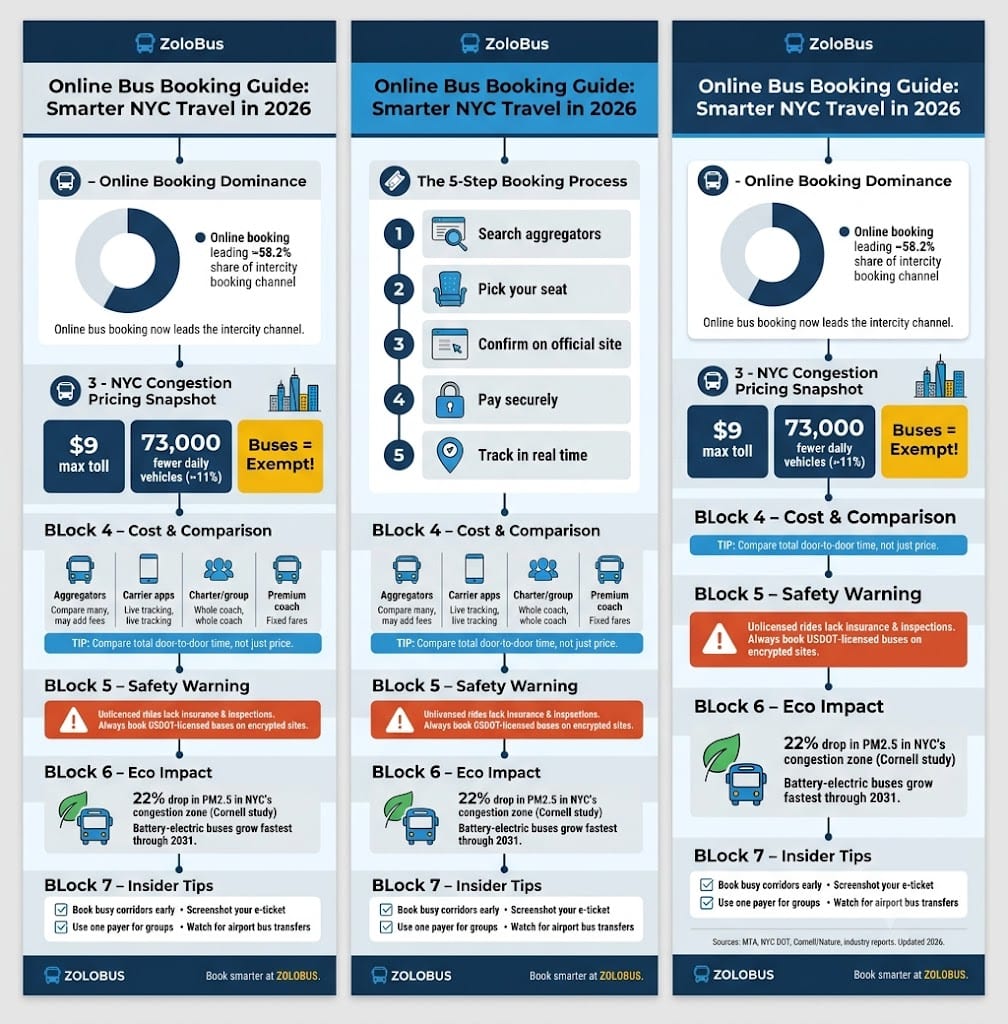
Here’s the thing—booking a bus used to mean lining up at a window and hoping the route still ran. Not anymore. The whole world of online bus booking has gone digital, and fast. A good Online Bus Booking Guide saves you from the two classic traps: overpaying, and showing up at the wrong curb. In terms of booking channel, the market is split into Online Booking, Phone Booking, and Direct Booking, and online booking is projected to lead with roughly a 58.2% share.
That said, it’s not a clean sweep yet—offline counter and agency sales still command over half the intercity bus travel market in some datasets, even as online aggregators and OTAs post the highest growth rate. So depending on whose report you read, online is either already winning or about to. Either way, the momentum’s clear, and learning the bus ticket booking process online pays off.
The broader market backs this up. The intercity bus travel market is projected to grow from roughly USD 19.4 billion in 2025 toward USD 38 billion by 2035, at a healthy single-digit CAGR. On the ticketing-tech side specifically, market size is forecast to climb from about USD 17.2 billion toward USD 52 billion by 2033. Why the surge? Key trends driving growth include smartphone penetration and digital payments adoption, plus operator digitization and inventory aggregation across routes. In plain English: more carriers list seats in an online bus reservation system, more aggregators pull them together, and you tap to pay for e-ticket bus travel. Lovely—when it works.

A Quick Bit of NYC Context
If you’re booking buses into or out of Manhattan, the 2026 reality still runs on the congestion-pricing shake-up. Since January 5, 2025, most drivers entering the area south of 60th Street (highways excepted) have faced charges of up to $9, with per-trip surcharges of roughly $0.75 for taxis and $1.50 for high-volume for-hire vehicles.
The early results were real: on a typical day, over 73,000 fewer vehicles enter the zone—about an 11 percent reduction on average. Faster streets, in other words. Now, the part bus riders love—intercity buses were granted an exemption from the new congestion fees, preserving affordability for travelers. One caveat worth flagging, though: construction at New York’s Port Authority Bus Terminal is ongoing and raises real concerns about service disruptions. So build in a buffer.
The Bus Ticket Booking Process: A Step-by-Step Online Bus Booking Guide
The bus ticket booking process isn’t hard, but a few moves separate a smooth trip from a stressful one. Here’s the online bus booking routine I follow, every single time.
- Search broadly first. Aggregators show you multiple carriers side by side. While mobile apps expand faster, browser-based channels still shine for detailed route comparison and itinerary planning. Use a big screen for planning, your phone for the actual e-ticket bus travel.
- Pick your seat and route deliberately. Select your specific seat at booking time to lock in your preferred level of privacy and legroom.
- Confirm on the official carrier site or bus reservation system. Always re-check the fare and departure point on the operator’s own page before paying. This catches the “same coach appears twice” confusion.
- Pay securely. Strong interface design, multilingual support, secure payment integration, and real-time seat mapping all improve booking clarity and transaction confidence.
- Track in real time. Use GPS-enabled “Track My Bus” features to see exactly where your coach is and get accurate arrival times.
Comparing Your Online Bus Booking Options
There’s no single “best” platform—it depends on your route and priorities. Here’s a fair look at the main paths in this transportation booking guide, with the honest trade-offs laid out.
| Booking Method | Pros | Cons |
|---|---|---|
| Aggregators / OTAs (e.g., Busbud, Wanderu) | Compare many carriers at once; great for route discovery | May add service fees; double listings can confuse |
| Carrier apps (FlixBus, Peter Pan, RedCoach) | Real-time tracking, digital boarding, easy rebooking | Only shows that carrier’s routes |
| Carrier websites (browser bus reservation system) | Best for detailed itinerary planning and corporate travel | Slower for on-the-go changes |
| Phone / counter booking | Human help; still roughly half the U.S. market | No live comparison; limited off-hours |
| Charter & group portals (charter bus reservation) | Whole-coach control; ideal for group transportation booking | Higher upfront cost; needs a coordinator |
| Premium coach services (e.g., ZoloBus, Vonlane) | Comfort, fixed fares, group-friendly | Higher base price than curbside budget lines |
A few notes on the players. In North America and Europe, operators and platforms such as Greyhound Lines, Megabus USA, Coach USA, and others keep investing in digital channels to improve booking efficiency and customer retention. On the aggregator side, names like Busbud and GotoBus stand out, focusing on extensive route networks and seamless booking experiences.
And increasingly, multimodal platforms such as BlaBlaCar and Trainline extend the value of online ticketing by linking bus journeys with trains and other modes. One real-world shift to plan around: the collapse of Coach USA led Megabus to withdraw from the New York–Washington, DC corridor, and Peter Pan and FlixBus quickly filled the void, boosting service frequency. So if you booked that route a couple years back, your old go-to carrier may have changed.
Insider Tips for Online Bus Booking
Over the years I’ve collected a handful of habits that just… save headaches. Here they are, no fluff.
- Go mobile for flexibility. Mobile apps offer instant booking, push notifications, geo-location support, digital boarding passes, and on-the-go rescheduling—e-ticket bus travel at its best.
- Book busy corridors early. Carriers like FlixBus have prioritized Northeast and warm-weather routes, increasing frequency on busy corridors like New York–Washington, DC. Popular departures fill up.
- Mind your luggage allowance. Some premium lines offer a generous policy including two free checked bags, a rarity in modern travel.
- Compare total time, not just price. By minimizing middle stops, some routes now rival the total door-to-door time of regional flights.
- Watch for airport-connected routes. Partnerships like Landline and American Airlines at Philadelphia International Airport offer smoother bus-to-flight transfers.
- Screenshot your confirmation. Cell service near terminals can drop. A saved e-ticket beats a spinning loading wheel.
- For group transportation booking, use one payer. Splitting seats across multiple bookings risks getting separated. One booking, one confirmation, fewer tears.
- App acting up? Try the browser bus reservation system. Web-based platforms still serve travelers who prefer structured booking, especially for planned intercity journeys and corporate travel.
YMYL Safety & Payment Warnings
This part isn’t optional reading. Unlicensed rides can lack proper insurance and safety inspections—if someone’s hustling cash-only “seats” curbside with no verifiable carrier name, walk away. Stick to recognized operators, book through encrypted sites (look for the padlock), and never wire money to a stranger to “hold” a seat. Financial-loss scams thrive on urgency, so slow down. If a deal feels too good, it usually is. This matters double for school transportation booking, where licensing and driver vetting are simply non-negotiable.
Traveler-Specific Advice
Different travelers, different priorities. A quick run-through from this transportation booking guide.
Budget travelers. Curbside and economy lines are your friend. Low-cost curbside services have rebounded as consumers grew more cautious with spending, and they’re often cheaper than alternatives. The trade-off is fewer frills—pack snacks, bring a charger.
Business execs. Premium weekday service and employee shuttle booking are built for you. The market is responding with weekday-centric premium schedules and corporate booking portals that plug into expense-management systems. The business segment is also among the fastest-growing slices of the industry.
Solo vs. group. Solo riders should grab a tracked, reserved seat near the front. Groups benefit from charter-style booking—private group rentals where an organization or tour operator books an entire coach for a customized itinerary. That’s where charter bus reservation and group transportation booking really shine.
Families, schools & accessibility. Book early to keep seats together, and confirm accessibility features directly with the carrier before paying—don’t assume. For school transportation booking, request driver credentials and inspection records in writing. A quick call beats a boarding-gate surprise.
Eco-conscious travelers. You’re already making a strong choice. The intercity motorcoach is consistently ranked among the most sustainable ways to move—a single bus can remove dozens of cars from the road, making it one of the lowest-emission motorized modes per passenger-mile. And in NYC, congestion pricing nudged things further: a Cornell study published in Nature found a 22% reduction in PM2.5 air pollution within the congestion relief zone during the first six months. Worth noting that’s zone-specific; citywide effects are more modest.
Emerging Trends: EVs, AI Pricing & Multimodal Booking
A couple of things on the horizon worth a glance. On fleets, diesel coaches still dominate the intercity bus market, but battery-electric buses are expected to expand at the leading growth rate between 2026 and 2031. So greener rides are coming, just not overnight. On the booking side, expect smarter pricing—companies leveraging data analytics and AI for dynamic pricing, route optimization, and demand forecasting are securing serious funding. Translation: fares may shift more like airline tickets in your favorite bus reservation system, so booking earlier often pays off. And the whole experience keeps blending modes—integrating bus services into the broader Mobility as a Service framework is a major trend, enabling comprehensive travel planning across transport types.
Was This Online Bus Booking Guide Helpful?
Tell us what you’d add—drop feedback at zolobus.com. We update this transportation booking guide quarterly after major schedule or policy changes.
FAQ
Online Bus Booking Guide: Why book buses online in 2026?
Booking at a window is old news. Online bus booking now leads the intercity channel with roughly a 58.2 percent share. It saves you from overpaying and from showing up at the wrong curb. With smartphones and digital payments rising, carriers list seats in a bus reservation system and aggregators pull them together. You tap to pay and get e-ticket bus travel in seconds. Honestly, it feels like a small win every trip.
Online Bus Booking Guide: What is the bus ticket booking process?
The bus ticket booking process is simple once you know it. Search aggregators to compare carriers. Pick your seat at booking for legroom and privacy. Confirm the fare and departure point on the official carrier site or bus reservation system. Pay on an encrypted page showing the padlock. Then track in real time with GPS Track My Bus tools. I plan on a big screen, then book e-ticket bus travel on my phone.
Online Bus Booking Guide: How much does intercity bus travel cost?
Cost depends on route, timing, and comfort. Budget curbside lines are often cheaper, which is why they rebounded with cautious spenders. Premium coaches charge more but add comfort and fixed fares. Compare total door-to-door time, not just the sticker price; a cheap seat with two transfers can cost you hours. With AI dynamic pricing, fares shift like airline tickets, so booking popular corridors early usually pays off.
Online Bus Booking Guide: Are unlicensed buses safe to book?
This is not optional reading. Unlicensed rides can lack proper insurance and safety inspections, risking your wallet and wellbeing. If someone hustles cash-only seats curbside with no carrier name, walk away. Stick to USDOT-licensed buses and encrypted sites with the padlock. Never wire money to hold a seat. This matters double for school transportation booking, where licensing and driver vetting are non-negotiable. One quick license check protects everyone.
Online Bus Booking Guide: How does NYC congestion pricing affect bus riders?
Since January 5, 2025, most drivers entering south of 60th Street face charges up to 9 dollars, with congestion surcharges near 0.75 dollars for taxis and 1.50 dollars for high-volume for-hire vehicles. That cut over 73,000 vehicles daily, about 11 percent. The good news for riders: intercity buses were granted an exemption, keeping fares affordable. One caveat, Port Authority construction may disrupt service, so build in a buffer.
Online Bus Booking Guide: Which booking platform should you choose?
There is no single best platform; it depends on your route. Aggregators like Busbud and Wanderu compare many carriers but may add fees. Carrier apps offer tracking and easy rebooking, yet show only that carrier. Carrier websites work as a solid bus reservation system for detailed planning. Phone booking still serves half the U.S. market. For airport bus transfers and group needs, charter portals or premium coach services shine.
Online Bus Booking Guide: What makes charter bus reservation worth it?
Charter bus reservation means renting a whole coach for a custom itinerary. That control is why group bus service beats stitching separate seats together. The trade-off is higher upfront cost and one coordinator, but savings add up. My rule for group transportation booking: one payer, one confirmation, so nobody gets separated. For weddings, sports teams, or company offsites, a single coach keeps everyone together and removes the chaos.
Online Bus Booking Guide: How do business travelers book smarter?
Premium weekday service and employee shuttle booking suit execs who value time. The market now offers premium schedules and corporate portals that plug into expense systems. The business segment is among the fastest-growing slices of the industry. A reserved premium seat with Wi-Fi turns transit into work time. For premium charter bus NYC needs, fixed fares ease budgeting. Book seats near the front and screenshot the confirmation, since terminal signal drops.
Online Bus Booking Guide: Are buses really eco-friendly?
You are making a strong choice. The motorcoach ranks among the most sustainable ways to move, since one bus removes dozens of cars, giving it one of the lowest emissions per passenger-mile. In NYC, a Cornell study in Nature found a 22 percent drop in PM2.5 within the congestion relief zone in six months. That figure is zone-specific, so citywide effects are modest. Battery-electric buses are set to grow fastest through 2031.
Online Bus Booking Guide: What insider tips save the most headaches?
A few habits save real headaches. Go mobile for instant booking, push alerts, and digital passes. Book busy corridors early, since popular departures fill up. Mind luggage limits; some premium lines include two free checked bags. Compare total time, not just price. Watch for airport bus transfers that link coaches to flights. Always screenshot your confirmation, because terminal signal drops. If the app fails, use the browser bus reservation system.
Online Bus Booking Guide: How do families and schools book safely?
Families and schools need extra care. Book early to keep seats together and confirm accessibility features before paying. For school transportation booking, request driver credentials and inspection records in writing, since licensing and vetting are non-negotiable. One verified, USDOT-licensed buses operator gives parents peace of mind. For accessibility, a quick call beats a gate scramble. Keep one payer for group transportation booking so nobody gets split across confirmations.
Online Bus Booking Guide: What booking trends should you watch in 2026?
A few shifts matter. Diesel coaches still dominate, but battery-electric buses should grow fastest between 2026 and 2031. Expect smarter pricing, as carriers use AI for dynamic pricing and demand forecasting, so fares in your bus reservation system behave like airline tickets; book early. The experience keeps blending modes through Mobility as a Service for end-to-end planning. For airport bus transfers especially, that seamless future feels close.
Sources
- Congestion Pricing in NYC – Wikipedia
- MTA Congestion Relief Zone
- NY Governor’s Office
- ABC7 New York
- Future Market Insights
- Mordor Intelligence
- Metastat Insights
- American Bus Association / Chaddick Institute
- RedCoach USA
- IBISWorld
- Online Bus Booking Guide – ZoloBus
Estimates may vary; verify pricing via TLC, MTA, and individual carrier sites. Updated October 09, 2026.
Meet the ZoloBus Editorial Team
Meet the ZoloBus Editorial Team—veterans like Alex Freeman (30 years navigating NYC chaos, TLC-certified, partnered with NYC DOT) and Emily Davis (20+ years on transport beats). I’m Emily, and honestly, I’ve coordinated rides across this city in pouring rain, holiday gridlock, and that weird quiet you only get at 5 a.m. near Port Authority. We’ve wrestled with the bus ticket booking process from every angle—delays, sketchy “unlicensed ride” pitches, and the plain joy of a clean e-ticket bus travel experience—to bring you real insights. Check our bios and partnerships at zolobus.com/editorial-team.

