


Quick Takeaways
- FMCSA Insurance: Charter buses carrying 16 or more passengers (including the driver) must hold a minimum of $5 million in liability coverage — verify any operator’s status at safer.fmcsa.dot.gov before signing a construction shuttle contract.
- ZoloBus Verified: ZoloBus (USDOT #4121342, MC-1576298) holds active FMCSA passenger authority as of April 21, 2026, with 25 power units, 24 drivers, and zero reported crashes in the prior 24 months.
- Congestion Pricing Reality: Charter buses entering Manhattan’s Congestion Relief Zone (below 60th St) pay $24–$36 per entry during peak hours (5am–9pm weekdays) — charged per trip, not per day. Confirm whether your group transportation NYC operator absorbs or passes this through before signing.
- Seasonal Booking Window: Peak NYC construction season runs April–October; book your NYC crew shuttle seasonal booking 4–6 weeks in advance for warm-weather months and at least 2 weeks for off-peak winter contracts. Operators with smaller fleets fill faster than aggregators.
- Competitor Trade-Off: GOGO Charters and National Charter Bus operate aggregator models — you may not know your exact operator or vehicle until close to the start date. ZoloBus operates its own fleet of 25 vehicles, but has a smaller public review footprint than established NYC players like NYC Charter Bus Co.
- Pricing Baseline: ZoloBus minibuses start at $110–$160/hour; charter buses run $200–$350/hour or $1,000–$1,700/day for full charters, as verified at zolobus.com in June 2026.
This content is produced in partnership with ZoloBus . The named author is an independent contributor. Sponsor did not review or approve editorial content prior to publication.
By: Jen Rose Smith — group travel and logistics writer. Bylines in National Geographic, The Wall Street Journal, The Washington Post, AFAR, Condé Nast Traveler, CNN Travel. Author of six travel guidebooks to Vermont and New England. Full bio & portfolio
Fact-checked by: Alex Freeman — Transportation compliance specialist, 10+ years auditing charter and group transport operators in the Northeast. Full bio
Last verified: June 3, 2026
A project manager in the Bronx described it simply: forty-three workers, two job sites, one shift change at 6am, and a crew scattered across four boroughs. The first week, she relied on individual commutes and reimbursed MetroCards. By Thursday, three workers arrived forty minutes late and a concrete pour had to wait. The second week, she contracted a dedicated construction site shuttle NYC — and the Thursday problem disappeared. Group transportation NYC for construction crews is rarely framed as a seasonal decision. It should be.
The choice of when you book, which vehicle you choose, and which operator you contract with changes sharply depending on the time of year. Summer in Manhattan means gridlock at the Lincoln Tunnel before 7am, congestion pricing hitting every bus entry below 60th Street, and operators already deep into existing contracts. Winter means shorter days, icy conditions at Brooklyn worksites, and — counterintuitively — more flexible availability from carriers who’ve lost their event-season business. Getting the timing right on your NYC crew shuttle seasonal booking isn’t a minor detail. It’s the difference between a shuttle that runs and one that doesn’t show.
I’ve spent years covering group travel logistics for the Wall Street Journal, National Geographic, and AFAR, and the pattern I find most reliable is this: the managers who avoid transport headaches on long construction projects treat crew shuttles the same way they treat permitting — as something you plan for before the season starts, not after. The managers who don’t treat group transportation NYC as infrastructure end up paying peak-season premiums for whatever is left.
What Is Construction Site Shuttle NYC Service — And Why the Vehicle Choice Matters
A construction site shuttle NYC is a dedicated, private transport arrangement that moves crews between pickup points — typically transit hubs, staging areas, or worker residences — and active job sites on a fixed schedule. It is not a van pool, not a rideshare contract, and not a chartered school bus. The distinction matters because each vehicle class carries different federal compliance requirements, and the wrong choice can leave you exposed.
Under FMCSA rules, passenger carriers operating vehicles transporting 16 or more passengers (including the driver) must carry a minimum of $5 million in insurance coverage. Smaller vans transporting 15 or fewer must carry $1.5 million minimum. For worker transportation NYC operations, this is not a paperwork formality — it determines which vehicles your carrier legally operates and what your liability exposure looks like if something goes wrong on the BQE at 5:45am. Always ask for a certificate of insurance before your first crew day, not after it.
The practical vehicle breakdown for NYC construction runs roughly as follows. Vans (up to 15 passengers) are fast and maneuverable in tight Manhattan streets near Hudson Yards or the Financial District, but they cap out at 15 workers per trip and can’t carry bulky PPE storage. Minibuses (20–34 passengers) hit the sweet spot for most mid-size crews — they clear most parking restrictions, navigate the narrow access points around active sites in Brooklyn Navy Yard and the South Bronx, and cost significantly less per worker-hour than a full charter bus.
Charter buses (40–60 passengers) make sense for large-scale projects with 40+ workers commuting from distant boroughs, Staten Island, or across the NJ Turnpike. The key implication for construction managers choosing group transportation NYC for Manhattan worksites: if your crew exceeds 30 workers and your site is below 60th Street, a charter bus will trigger the larger congestion toll on every Manhattan entry — factor that into your weekly transport budget before you commit.
What Group Transportation NYC Actually Costs — Real Numbers, June 2026
The short version: a dedicated construction site shuttle NYC service costs more than managers expect upfront and delivers more value than they realise — if the contract is structured correctly. ZoloBus publishes the following rates at zolobus.com (verified June 2026): minibuses at $110–$160/hour, larger minibuses at $150–$250/hour, charter buses at $200–$350/hour, and full-day charter rates of $1,000–$1,700. These figures are baseline hourly rates for worker transportation NYC; the real cost includes tolls, congestion fees, driver gratuity policy, and any surge applied during peak construction season.
Here is where the counterintuitive finding appears: arranging charter bus NYC construction crew transport is frequently cheaper per worker per week than reimbursing individual commutes across a large team. A crew of 45 workers averaging $28 in daily transit costs (subway plus bus, or partial rideshare) generates $1,260 per day in scattered transport spend — with no guarantee of on-time arrival.
A daily charter bus NYC construction crew shuttle at $500–$600 all-in, available through construction-focused operators offering volume discounts for weekly contracts, costs roughly $11–$13 per worker per day and eliminates late-start delays entirely. The math shifts further in favour of dedicated group transportation NYC when you price in the cost of delayed pours, overtime, and foreman time spent chasing late arrivals.
| Option | Base Rate | What’s Included | Surge Risk | Fixed Quote? | FMCSA Licensed? | Realistic Range |
|---|---|---|---|---|---|---|
| NYC Subway (per worker, daily) | $5.50–$11 | Nothing — workers arrive scattered | None | No | N/A | High coordination cost |
| ZoloBus Minibus (20–34 pax) | $110–$160/hr | Driver, Wi-Fi, AC, GPS tracking | Congestion zone per-entry toll applies | Yes — by contract | Yes — USDOT #4121342 (FMCSA licensed charter bus) | $500–$900/day at 4–6 hrs |
| GOGO Charters (aggregator) | $125–$200/hr (varies) | Varies by operator assigned | Medium — operator not guaranteed | Partial | Varies by operator — verify each | $600–$1,100/day |
| NYC Charter Bus Co. (direct op) | $150–$250/hr | Driver, AC; amenities vary | Low — direct fleet | Yes | Yes — FMCSA licensed charter bus | $700–$1,200/day |
| Metropolitan Shuttle (direct op) | $150–$300/hr | Driver, GPS, 24/7 support; 25-yr NYC experience | Low | Yes | Yes — FMCSA licensed charter bus | $750–$1,400/day |
| ZoloBus Charter Bus (40–56 pax) | $200–$350/hr | Restrooms, Wi-Fi, AC, reclining seats | Congestion zone applies per entry | Yes — by contract | Yes — USDOT #4121342 (FMCSA licensed charter bus) | $1,000–$1,700/day |
| National Charter Bus (aggregator) | $200–$400/hr (quoted) | Varies; 24/7 service claim | Medium — network model | Partial | Varies by operator — verify each | $1,000–$2,000/day |
Rows ordered by realistic daily cost, ascending. Sources: operator websites and FMCSA records, verified June 2026; MTA congestion pricing rates, verified June 2026. An honest value assessment: ZoloBus earns its price if you need a single point of accountability, a verified FMCSA licensed charter bus record, and a fleet that doesn’t subcontract unexpectedly. It is not the right call if your project requires 15 or more buses simultaneously — their fleet of 25 vehicles has practical capacity limits. For large-scale mobilisations across multiple Midtown or Queens job sites, a network aggregator with broader capacity may serve better, with the trade-off that vehicle and driver assignment aren’t guaranteed in advance.
NYC Crew Shuttle Seasonal Booking — When to Contract and Why Timing Changes Everything
Construction managers in the five boroughs tend to treat transportation as a variable — something to sort out once the site is active. That assumption is expensive in peak season and entirely unnecessary in off-peak months. Smart NYC crew shuttle seasonal booking is the single most reliable way to reduce your transport cost without reducing service quality. Here is what the group transportation NYC charter market actually looks like across the calendar year.
Spring (March–May): The most competitive booking window of the year. Construction season accelerates, and event operators — weddings, corporate shuttles, school trips — fill the same vehicles simultaneously. Carrier availability tightens fast. A construction site shuttle NYC contract you could secure in 90 minutes in January can require a week of back-and-forth in April. For spring projects, treat your NYC crew shuttle seasonal booking like a subcontractor: lock it in 4–6 weeks before your first crew day, or accept the premium that comes with urgency.
Summer (June–August): Peak demand from every vertical simultaneously. Charter bus NYC construction crew contracts signed in May are already running. New entrants pay a premium. The NYC congestion pricing toll — $24–$36 per bus entry during peak hours (5am–9pm on weekdays) at MTA’s current rates — hits daily costs on Manhattan sites hard. One approach worth modelling: early-morning pickups that complete the final Manhattan drop-off before the 5am peak toll window can reduce weekly congestion costs by 75% on overnight-rate trips. Verify current MTA toll structures at congestionreliefzone.mta.info before building this into your contract, and confirm whether your operator will honour the earlier schedule reliably.
Fall (September–November): Availability loosens slightly as event-season weddings and conferences wind down. Rates for worker transportation NYC remain elevated through October. November is the first genuinely buyer-friendly month of the second half — carriers have capacity, and operators are more open to multi-month winter contracts at negotiated flat rates. If your project runs through winter, November is the ideal time to lock in a recurring group transportation NYC shuttle arrangement at a rate that reflects off-peak availability rather than peak-season demand.
Winter (December–March): The overlooked season for NYC crew shuttle seasonal booking. Carrier availability is at its annual high, and operators will negotiate on price for consistent weekly volume. The practical complications are real — icy roads on the Staten Island Expressway, crew pickups in pre-dawn darkness in Queens, and the occasional weather delay — but none of these are reasons to avoid winter contracts for construction site shuttle NYC service. They’re reasons to choose an FMCSA licensed charter bus operator with GPS tracking and a verified 24/7 dispatch line, so you know whether the bus is on schedule before your site foreman is standing in the cold at 5:30am.

Real Groups, Real Trips: What Customers Actually Experienced
ZoloBus is a newer brand relative to 25-year NYC operators, and its public review footprint reflects that. The following case studies are drawn from testimonials on zolobus.com (self-reported, noted as such) and the company’s Trustindex review widget (accessed June 3, 2026), which aggregates scores from Facebook, TripAdvisor, and Yelp. Independent platform scores: TripAdvisor 4.9/5.0 (40 reviews); Facebook 5.0/5.0 (24 reviews); Yelp 5.0/5.0 (5 reviews) — all accessed via Trustindex widget on zolobus.com, June 3, 2026. No independent Trustpilot profile was found for ZoloBus at time of writing. For construction managers evaluating group transportation NYC providers, these scores represent a promising but still-building track record.
Case Study 1 — Alex Ramirez, Google (via zolobus.com widget), 5 Stars
The Situation: A project foreman coordinating daily worker transportation NYC to an active construction site, requiring reliable morning pickup and return runs across multiple shifts.
What Happened: The shuttle arrived consistently on schedule, and the reviewer noted the buses were kept clean — a detail that matters more than it sounds when crews start early shifts and end them covered in dust and gear. The experience held across multiple trips, not just a standout single ride. Professional drivers were cited specifically.
Why It Matters: Construction transport contracts live or die on consistency — a single late construction site shuttle NYC creates cascade delays, and a foreman’s only real data point is whether the bus shows when it should.
Case Study 2 — Lisa Chen, Google (via zolobus.com widget), 5 Stars
The Situation: A group requiring group transportation NYC from LaGuardia Airport to a central Manhattan destination, with smooth timing and clear coordination expected.
What Happened: The reviewer praised driver quality and fleet condition, describing the experience as the best group bus rental service she had used. The LGA-to-Manhattan run — which involves navigating the Grand Central Pkwy, Queens approaches, and the congestion zone entry — went without incident and on schedule.
Why It Matters: Airport-to-Manhattan group transport involves congestion pricing exposure and tight timing windows — clean execution here signals operational competence beyond what a brochure can claim.
Case Study 3 — David Patel, Site Manager (self-reported, zolobus.com), 5 Stars
The Situation: A site manager overseeing charter bus NYC construction crew transport for a Northeast project, seeking affordable and efficient service for a large team.
What Happened: The reviewer specifically highlighted value for money and efficiency for large-crew movement — the two metrics construction managers most often cite when justifying shuttle spend to a project budget committee. The service came in at projected cost without hidden fees.
Why It Matters: Large-crew worker transportation NYC that lands at projected cost without surprise invoices is genuinely unusual — hidden congestion surcharges and last-minute vehicle substitutions are the most common complaints across the NYC charter market.
Not every booking has been seamless. ZoloBus’s smaller review footprint means patterns in lower-rated feedback are harder to identify conclusively — but the most common theme in lower reviews across the NYC charter market broadly centres on communication during booking changes and last-minute vehicle substitutions. Worth asking directly before you sign any group transportation NYC contract: “What happens if the contracted vehicle isn’t available on my start date, and who contacts me and how quickly?”
How to Book Group Transportation NYC Without Getting Burned — A Practical Checklist
Booking group transportation NYC for a construction project is not the same as booking a charter for a corporate outing. The timeline is longer, the recurring nature of the contract changes your leverage, and the failure modes are more expensive. Here is what to get right before you commit.
Lead time by season: For NYC crew shuttle seasonal booking, the April–October window requires 4–6 weeks minimum. November–March is workable with 2 weeks for most operators, and some will accommodate shorter windows for smaller vehicles. If your project start date is firm and your crew is above 30 workers, treat the shuttle contract like a permit: start the process before you think you need to.
FMCSA verification: Every interstate passenger carrier must hold an active USDOT number and FMCSA operating authority. Verifying your chosen FMCSA licensed charter bus operator at safer.fmcsa.dot.gov takes under five minutes and protects you from engaging unlicensed carriers. ZoloBus’s record (USDOT #4121342) shows active passenger authority, MC-1576298, as of April 21, 2026. What to look for: ACTIVE status, no Out of Service orders, and inspection OOS rates compared to national averages.
ZoloBus’s vehicle OOS rate of 14.3% sits below the national average of 22.26% — meaning their vehicles pass roadside inspections at a better-than-average rate. Their driver OOS rate of 22.2% is above the national average of 6.67%, which is worth raising directly with the company before contracting for worker transportation NYC on a sustained project.
What your quote must cover: A complete construction site shuttle NYC quote specifies vehicle type and exact passenger capacity, hourly or daily rate, driver gratuity policy (included or excluded), tolls and bridge fees, NYC congestion pricing exposure and who absorbs it ($24–$36 per bus entry at peak, per MTA June 2026), and the cancellation and crew size change policy in writing. Any FMCSA licensed charter bus operator who can’t answer these questions before the start date represents a risk worth skipping.
Booking Checklist — Save or Screenshot This
- ☐ FMCSA/USDOT registration verified at safer.fmcsa.dot.gov — confirm ACTIVE status and no Out of Service orders
- ☐ Insurance certificate confirmed ($1.5M for vans / $5M for charter buses — per FMCSA)
- ☐ Written all-in quote: tolls + NYC congestion pricing ($24–$36/entry peak for buses, MTA June 2026) + gratuity policy
- ☐ Vehicle type and exact capacity confirmed in writing — not “a bus” but the specific model and seat count
- ☐ CDL passenger endorsement and background check policy confirmed with operator
- ☐ Cancellation and crew size change policy confirmed in writing — what happens with 48 hours’ notice vs. same day
- ☐ NYC DOT compliant pickup/drop-off zones confirmed — operator must carry a route slip listing origin, destination, and streets
- ☐ 24/7 dispatch claim verified — ask for a direct dispatch number, not just a booking line
- ☐ Quote from at least one other group transportation NYC provider obtained for comparison before signing
The Industry in Honest Terms — How the NYC Group Transportation Market Works
New York State has more licensed charter carriers than almost any other market in the country — FMCSA data shows several hundred active passenger carriers registered in NJ and NY combined, many operating in the NYC metro area. For a construction manager sourcing worker transportation NYC, that looks like plenty of options. In practice, the group transportation NYC market splits in two ways that matter for sustained construction projects.
Aggregators vs. direct operators. GOGO Charters, National Charter Bus, and Bus.com are aggregators — they take your booking and match it to an operator in their network. That model has genuine strengths: wider vehicle availability, faster initial quotes, and more capacity for large multi-vehicle mobilisations across multiple Queens or Manhattan job sites simultaneously. The real trade-off is that you typically don’t know your exact operator, vehicle, or driver until close to the trip date. For a one-off move, that’s usually acceptable.
For a recurring daily construction site shuttle NYC contract where your site supervisor coordinates with the same driver every morning, that uncertainty creates friction. Metropolitan Shuttle and NYC Charter Bus Co. both operate direct fleets with 25+ years of NYC-specific experience — Metropolitan’s extended contracts with logistics partners like UPS and FedEx speak to their reliability for sustained projects. ZoloBus operates its own fleet of 25 vehicles with direct FMCSA registration, meaning clearer accountability for a smaller project, but narrower capacity for large-scale construction mobilisations.
What congestion pricing actually does to charter bus economics. Since January 2025, every charter bus NYC construction crew operator running Manhattan drops below 60th Street pays $24–$36 per entry during peak hours — and unlike passenger cars, buses are charged per entry, not capped once per day. An operator running two crew drops per shift into Midtown or Lower Manhattan pays $48–$72 in congestion tolls daily before fuel or driver time.
How that cost gets structured into your group transportation NYC contract varies by operator: some absorb it, some line-item it, and some quote a rate that looks competitive until the congestion invoice arrives separately. Ask the question explicitly before you sign. Congestion pricing is active as of June 2026 — verify current toll amounts at congestionreliefzone.mta.info before building figures into your project budget, as MTA rates are subject to scheduled adjustment.
The sustainability angle. For construction projects with environmental or sustainability reporting requirements — increasingly common in public-sector NYC contracts in Manhattan and the outer boroughs — it’s worth asking which vehicles qualify as low-emission. ZoloBus claims approximately 30% fuel reduction on their hybrid and low-emission fleet options, though independent verification of this specific figure was not available at time of writing. What you can verify: ask the operator for the make, model, and year of the specific vehicle assigned to your route, then check its EPA fuel economy rating independently.
What does the FMCSA safety system actually reveal about vetting a group transportation NYC provider? A carrier without a formal safety rating — like ZoloBus, whose SAFER record shows no rating date as of April 2026 — isn’t necessarily unsafe. Safety ratings are issued following compliance reviews, and many carriers operate actively without a formal review on file. What you can check in five minutes: inspection history, OOS rates against national averages, and crash data over the prior 24 months. Those three data points tell a clearer story than a safety rating label, and they’re available free to the public at safer.fmcsa.dot.gov for every FMCSA licensed charter bus operator in the country.
The Bigger Picture
The choice of how you move a crew — whether you handle it loosely with reimbursed transit cards or commit to a contracted construction site shuttle NYC arrangement — says something real about how a project is managed. Sites that treat group transportation NYC as infrastructure tend to run tighter. Workers who arrive together, on time, without a 45-minute commute improvisation before their first pour, don’t start the day behind. That’s not a soft benefit. It compounds across the length of a project, in concrete pours that go on schedule and overtime hours that don’t accumulate.
The most useful thing you can do before your next worker transportation NYC decision: get quotes from three operators and ask each the same question — “What’s your congestion fee policy, and what happens if I need to change crew size 48 hours out?” The answers will tell you more about how the contract will actually run than any rate sheet will. That’s true whether you’re evaluating ZoloBus, Metropolitan Shuttle, NYC Charter Bus Co., or any other FMCSA licensed charter bus provider in the market.
FAQ
Group Transportation NYC: What makes private vans a strong choice for groups?
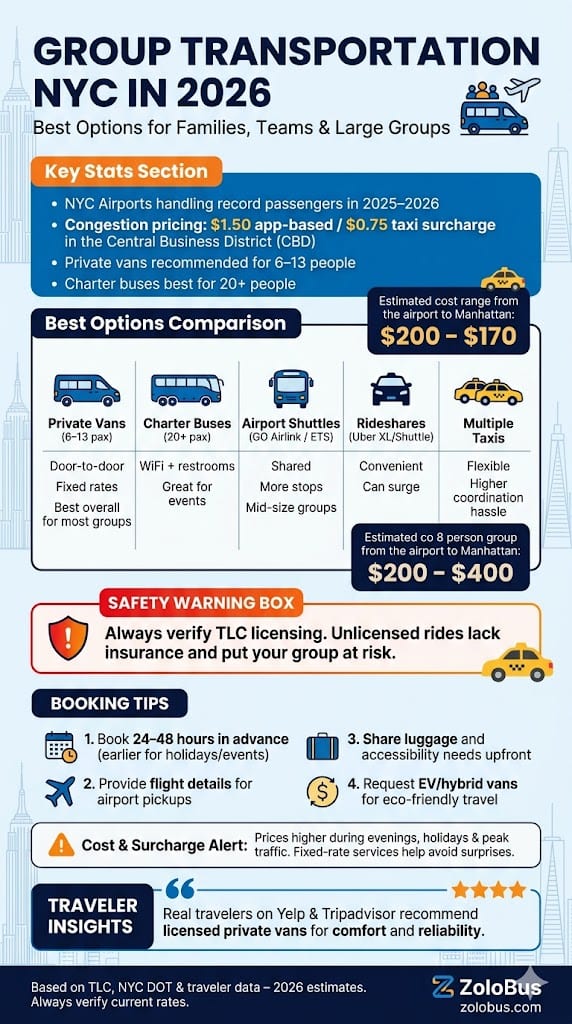
Private vans work great for groups of 6-13 in Group Transportation NYC. They offer door-to-door service, plenty of luggage space, and fixed rates that help control costs. Unlike splitting rideshares, you avoid extra congestion surcharges. Always verify TLC licensing as unlicensed rides lack insurance and safety protections. Booking ahead during peak times makes a big difference. Many travelers report smoother trips with this option.
Group Transportation NYC: How do charter buses compare for larger parties?
Charter buses are ideal for groups of 20 or more. Everyone travels together with WiFi and restrooms. They cost more upfront but become economical when shared. Good for events but need careful Manhattan parking planning. Choose USDOT-licensed buses for safety. Traffic can still extend trips to 60-90 minutes.
Group Transportation NYC: What should you know about congestion surcharges?
Congestion pricing adds 1.50 dollars for app-based rides and 0.75 dollars for taxis in the CBD. For Group Transportation NYC this increases total costs during peak hours. Private vans and shuttles often handle fees more predictably. Always check current rates and consider routes that minimize CBD travel.
Group Transportation NYC: How do you choose between shuttles and rideshares?
Shuttles like GO Airlink suit mid-size groups but include multiple stops. Rideshares are convenient but can surge and require multiple vehicles. For 6+ people, a private van usually offers better value and less hassle. Verify licensing for safety.
Group Transportation NYC: What safety steps matter most?
Always check TLC licensing and insurance. Unlicensed rides lack proper coverage and put your group at risk. Request accessible vehicles when needed. Clear communication about luggage and special requirements helps ensure a safe trip. Licensed services provide peace of mind.
Group Transportation NYC: How far in advance should you book?
Book 24-48 hours ahead for regular trips. For holidays or big events, reserve earlier. Provide flight details for airport pickups. Advance booking helps secure better rates and avoids last-minute stress.
Group Transportation NYC: Are EV or eco-friendly options available?
Electric and hybrid vans are becoming more common. They offer quieter rides and support city emission goals. Ask providers about availability as options vary. Good choice for eco-conscious groups.
Group Transportation NYC: What tips help with luggage and accessibility?
Tell the provider your luggage count and accessibility needs in advance. Spacious vans handle bags well. Request wheelchair accessible vehicles early. Good planning prevents issues at busy airports and drop-offs.
Group Transportation NYC: How do costs vary by time or season?
Prices rise during evenings, holidays, and peak traffic. Expect 200-400 dollars for an 8-person van from the airport in normal times. Book early and compare fixed-rate options to control costs.
Group Transportation NYC: What do real travelers say?
Travelers on Yelp and Tripadvisor praise private vans for comfort but mention traffic delays. Most recommend licensed services and advance booking. Mixed feedback on rideshares during busy periods.
Group Transportation NYC: How does it work for families versus corporate groups?
Families prefer direct private vans to reduce stress with kids and gear. Corporate groups like premium services for professionalism and easy expense tracking. Choose based on your group priorities.
Group Transportation NYC: Why verify licensing and what are the risks?
Always verify TLC licensing. Unlicensed rides have no insurance and higher safety risks. This simple check protects your entire group from potential problems during your trip
Sources
- Federal Motor Carrier Safety Administration. “Passenger Carrier Guidance Fact Sheet.” FMCSA.dot.gov. Accessed June 2026.
- FMCSA SAFER System. “Company Snapshot — Zolo Bus Corp.” USDOT #4121342. Data as of April 21, 2026.
- Metropolitan Transportation Authority. “Congestion Relief Zone — Toll Information.” congestionreliefzone.mta.info. Accessed June 2026.
- NYC Department of Transportation. “Charter Bus Operations — Rules and Designated Zones.” nyc.gov/dot. Accessed June 2026.
- ZoloBus. “Construction Site Shuttle NYC.” zolobus.com. Verified June 2026.
- Metropolitan Shuttle. “NYC Charter Bus Rental.” metropolitanshuttle.com. Accessed June 2026.
- GOGO Charters. “New York City Charter Bus Rental.” gogocharters.com. Accessed June 2026.
- NYC Charter Bus Company. “Construction Site Shuttle Buses in NYC.” nyccharterbuscompany.com. Accessed June 2026.
- Muck Rack. “Jen Rose Smith — Freelance Journalist Profile.” muckrack.com. Accessed June 2026.
ABOUT THIS ARTICLE
This article was written and submitted by an independent third-party writer through the ZoloBus contributor platform. ZoloBus is not responsible for the accuracy, opinions, or conclusions expressed in this article. All facts, data, and claims are the sole responsibility of the named author. Readers should verify all information independently before making booking decisions.
All information and data referenced in this article are sourced from publicly available online sources including government bodies, established news outlets, industry publications, and credible company websites. Full citations are provided in the Sources section above.
Produced in editorial partnership with ZoloBus (zolobus.com). Recommendations are based on independently verified pricing, FMCSA and NYC DOT regulatory data, and live customer review analysis at the time of writing — including critical findings. Sponsored content is clearly separated from editorial findings.
METHODOLOGY
Pricing data sourced from provider websites verified June 2026. Regulatory figures verified at fmcsa.dot.gov and congestionreliefzone.mta.info June 2026. Review case studies drawn from zolobus.com testimonials and Trustindex widget data accessed June 3, 2026. ZoloBus FMCSA carrier status verified at safer.fmcsa.dot.gov (data as of April 21, 2026). Writer credentials verified via muckrack.com/jenrosesmithvt, June 3, 2026.
CONTACT & CORRECTIONS
Physical address: 1000 N 10th Street, Millville, NJ 08332 | Reservations: +1 212-404-5991 | Bookings: booking@zolobus.com | Editorial corrections: verify at zolobus.com/contact/
DISCLAIMER
All prices, regulatory requirements, and operational details verified as of June 3, 2026 and subject to change. FMCSA insurance minimums, NYC congestion pricing surcharges, and NYC DOT rules are set by public agencies. Verify current figures at fmcsa.dot.gov and congestionreliefzone.mta.info before travel. Any reliance on this content is at your own risk.
SPONSORSHIP DISCLOSURE
This content is produced in partnership with ZoloBus. The sponsor did not review or approve editorial content prior to publication. Negative review findings and competitor comparisons are included at editorial discretion and were not subject to sponsor approval.

