


Quick Takeaways — Healthcare Transport Bus NYC 2026
- Healthcare transport bus nyc isn’t one thing — it’s paratransit vans, Medicaid ambulettes, nonprofit shuttles, hospital loops, and private group medical transport nyc charters, all under different rules and serving different riders.
- MTA Access-A-Ride — the city’s main paratransit bus nyc option — currently charges $3.00 per trip; Fair Fares NYC members pay $1.50. Most affordable regulated option, full stop.
- Medicaid NEMT covers ambulette service nyc at zero out-of-pocket for eligible members — but only if the trip is pre-authorized, medically documented, and handled by an enrolled vendor.
- NYC congestion pricing, running since January 2025 and fully embedded in the 2026 transport landscape, adds $0.75 per yellow taxi trip and $1.50 per Uber/Lyft trip into the Manhattan CBD — real added cost for patients making recurring healthcare transport bus nyc runs below 60th Street.
- CBD traffic speeds rose roughly 15% since congestion pricing launched — afternoon medical shuttle bus nyc runs that used to crawl through Midtown gridlock now move meaningfully faster in 2026.
- Unlicensed informal rides — Facebook-group vans, uncertified “cheap medical taxis” — carry no commercial insurance and no Article 19A certification. That’s your risk if something goes wrong, not theirs.
- Project CART (NYC Foundation for Senior Citizens) runs free van rides for adults 60+ in Manhattan Community Districts 1–8. Most people searching for accessible transport nyc have never heard of it. Call (212) 956-0855.
- Charter bus medical nyc services like ZoloBus fill the gap for recurring group runs — dialysis centers, senior day programs, post-discharge shuttles — where public programs won’t flex around your schedule.
- Before booking anyone, verify their TLC base number, DOT authority, and commercial insurance. Any legitimate healthcare transport bus nyc operator shares those without hesitation.
- Keep a written ride log — date, vehicle number, driver name, any issue. One documented complaint backed by specifics moves faster through MAS or MTA channels than ten verbal ones ever will.
Let Me Be Honest With You About Healthcare Transport Bus NYC
There’s a moment I keep coming back to. Flatbush, grey Tuesday, maybe six years ago. A dialysis patient — late sixties, folding wheelchair, made this healthcare transport bus nyc run three times a week for years — was waiting on her stoop at 6:45 a.m. The ride never came. Three rideshares drove past. None of them wanted to deal with the chair. She missed her treatment window. Her daughter called me furious, scared, and I didn’t have a clean answer for her.
That’s what healthcare transport bus nyc means in practice for a lot of families in this city. It’s not a content category. It’s the difference between getting treatment and not. And New York — for all its transit infrastructure — still has a genuinely uneven system when it comes to medical shuttle bus nyc access in 2026. Some of it excellent, some deeply unreliable, too much of it confusing to navigate when you’re already managing a health crisis.
So here’s what I know after 20 years on this beat.
Congestion pricing launched in January 2025 and is now a fixed part of the 2026 NYC transport landscape. CBD average speeds have settled at roughly 9.7 mph — up from 8.2 mph before the program — a 15% gain that matters when you’re timing a healthcare transport bus nyc pickup around a chemo infusion or post-op appointment. Afternoon paratransit bus nyc windows that used to eat 20–30 extra minutes in Midtown gridlock move more reliably now. On the other side, every taxi and FHV entering the CBD carries a $0.75 or $1.50 per-trip surcharge — real added cost for patients on fixed incomes running recurring group medical transport nyc appointments.
There is no single healthcare transport bus nyc system in 2026. What exists is a web: public paratransit, Medicaid-funded ambulette service nyc, nonprofit vans, hospital shuttles, and private charter bus medical nyc operators. Some are free. Some are fully covered. Some cost hundreds for a single trip if you’re not careful about what you’re booking. The sections below break down each option so you can match the right one to your actual situation.
One flag before we go further: this is YMYL territory — your health, your money, sometimes your safety. I’ve called out unlicensed rides throughout this piece not for dramatic effect but because I’ve seen what happens when a wheelchair securement fails in a van with no Article 19A certification. Verify licensing. Verify insurance. Verify the complaint process. Every time.
5 Real Options for Healthcare Transport Bus NYC in 2026
1. MTA Access-A-Ride — The Core Paratransit Bus NYC Option
Access-A-Ride is the MTA’s federally mandated door-to-door paratransit bus nyc service for riders whose disabilities prevent them from using regular buses and subways. In 2026 the fare remains $3.00 per trip — or $1.50 with Fair Fares NYC enrollment. Eligibility isn’t automatic; there’s an application and sometimes a functional assessment. Start the process well before your first appointment.
The catch most new riders don’t learn until the third or fourth trip: rides are shared by default. You might board at 8:00 a.m. for a 9:30 healthcare transport bus nyc appointment and arrive at 10:15 because two other passengers had stops along the route. That’s not a driver failure — that’s the shared model working as designed. A commenter on r/AskNYC described a 90-minute ride that Google Maps showed as 22 minutes. They weren’t wrong about the distance. For recurring predictable appointments — dialysis three times a week, weekly chemo — timing patterns become learnable. For one-off trips or tight windows, build significant buffer and have a backup plan.
Booking typically requires the day before. Same-day accessible transport nyc through Access-A-Ride usually doesn’t work. For caregivers coordinating medical logistics around this paratransit bus nyc service, that constraint shapes every other backup plan you build.
2. Medicaid NEMT and Ambulette Service NYC — Free If You Navigate It Correctly
Medicaid Non-Emergency Medical Transportation can cover ambulette service nyc rides — wheelchair vans, lift-equipped minibuses — at zero out-of-pocket for eligible members in 2026. A lot of people who qualify still aren’t using it simply because they don’t know it exists or can’t get through the authorization process.
How it works: you contact your Medicaid managed care plan or Medical Answering Services (MAS), which handles a large slice of NYC Medicaid transport volume. You request a healthcare transport bus nyc ride to a covered medical appointment. MAS approves it if medically necessary, assigns an enrolled vendor, schedules the pickup. Build in at least two weeks for new authorizations. Keep physical copies of every approval number. Save the complaint line — different from the booking line — and call it same-day if a ride fails. Same-day complaints build the accountability record that gets bad ambulette service nyc vendors removed from the program.
Ambulette service nyc providers must hold a Common Carrier Certificate or Contract Carrier Permit from NYS DOT, Article 19A compliance from NYS DMV, and active Medicaid enrollment. The NYC moratorium on new ambulette providers lifted December 1, 2021 — but the compliance bar remains real and meaningful for riders. A Yelp review I came across while researching stuck with me: “Driver didn’t know how to lock the wheelchair. I asked him to show me the certification. He couldn’t.” That’s a licensing failure that a properly credentialed ambulette service nyc operator would never create.
3. Project CART and City Aging Programs — The Accessible Transport NYC Most People Miss
Project CART, run by the New York Foundation for Senior Citizens, provides free van rides to medical appointments, hospitals, senior centers, and social services for adults 60 and older in Manhattan Community Districts 1 through 8. It’s been operating for over 30 years and remains one of the most underused accessible transport nyc resources in 2026. Call (212) 956-0855 to book.
It’s not citywide — that’s the honest limitation. South Bronx, East New York, parts of Queens — this isn’t your option. But for eligible riders in lower and mid-Manhattan it removes the cost equation entirely. NYC’s Department for the Aging and some borough-level aging offices also run or contract local group medical transport nyc programs. Call 311 and ask specifically: “What free senior transportation is available near [zip code]?” You’ll often surface accessible transport nyc resources that don’t appear on any Google search.
4. Hospital and Clinic Medical Shuttle Bus NYC — Only Works If the Route Fits
Several major NYC health systems run their own medical shuttle bus nyc loops in 2026 — between campuses, from transit hubs to the main facility, sometimes from specific housing developments where large patient populations live. Free for patients of that system, timed to clinic hours, and staffed by drivers who know the boarding protocol. If the route works for your situation, it can be the smoothest healthcare transport bus nyc option available.
The problem: almost nobody knows these medical shuttle bus nyc routes exist. Ask your patient coordinator — not the front desk, not billing. If you’ve been receiving treatment at one facility for months and haven’t asked, ask now. Downside when you do find one: fixed schedule, fixed route, first-come seating. Miss the window and you’re arranging alternatives anyway.
5. Charter Bus Medical NYC — For Groups That Need Consistency in 2026
This is where charter bus medical nyc operators like ZoloBus fit the healthcare transport bus nyc picture in 2026. Licensed buses and minibuses for recurring group medical transport nyc runs. A senior housing complex in Flushing sending 15 residents to a dialysis center in Rego Park three times a week. A behavioral health clinic in the Bronx running a Thursday group therapy healthcare transport bus nyc shuttle to a Manhattan outpatient program. An adult day health program building a weekly loop from three Queens zip codes to one facility.
Charter bus medical nyc isn’t Medicaid-covered — it’s a direct-pay or organizational-contract model. But for organizations that have tried to piece together 15 individual Medicaid NEMT authorizations for 15 different patients every week, one contracted group medical transport nyc vehicle at a fixed time changes the operational reality entirely. A Tripadvisor reviewer of a comparable NYC group transport operator captured it plainly: “Same driver, same bus, every Monday. Our residents knew his name by week two. That matters.” Um, yeah. It does — especially when your riders are managing complex health needs week after week.

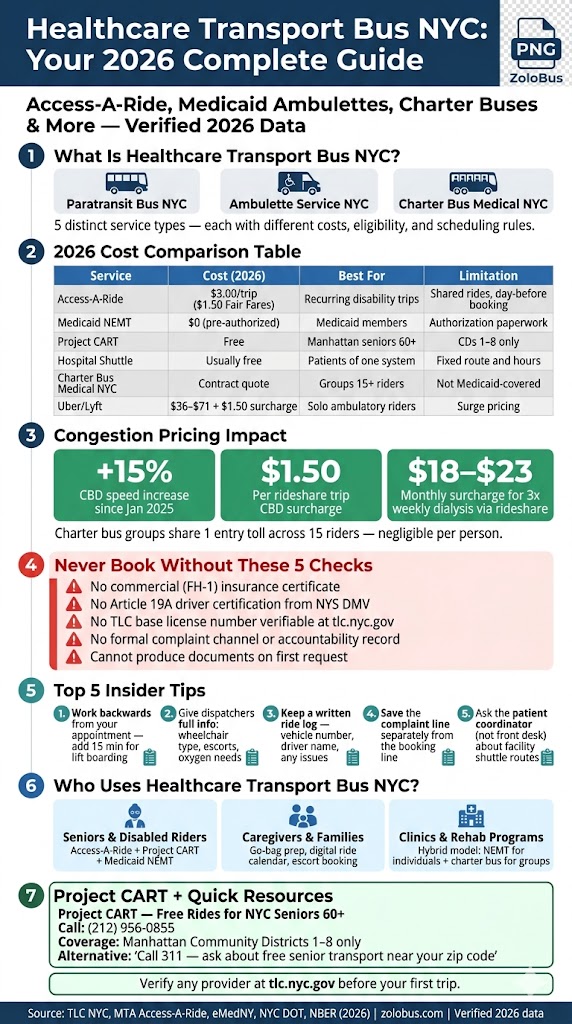
Healthcare Transport Bus NYC — All Options Side by Side
| Option | Best for | Cost (approx. 2026) | Licensing | Honest limitation |
|---|---|---|---|---|
| MTA Access-A-Ride (paratransit bus nyc) | Qualifying disability, recurring appointments | $3.00/trip ($1.50 Fair Fares) | MTA paratransit; TLC vehicles | Shared rides; advance booking only |
| Medicaid NEMT / ambulette service nyc | Medicaid members with documented medical need | $0 if properly authorized | NYS DOH enrollment; Article 19A; DOT carrier authority | Authorization paperwork; variable vendor quality |
| Project CART — accessible transport nyc | Adults 60+ in Manhattan CDs 1–8 | Free | NYC Dept. for the Aging funded | Manhattan CDs 1–8 only |
| Hospital / clinic medical shuttle bus nyc | Patients of one specific health system | Usually free | Health system contracts | Fixed route/hours; limited seats |
| Charter bus medical nyc (ZoloBus etc.) | Groups, recurring runs, org contracts | Contract-based; get written quote | TLC base license; DOT authority; commercial insurance | Not Medicaid-covered; needs advance planning |
| Uber / Lyft (FHV) | Solo, ambulatory, non-recurring | $36–$71+ incl. $1.50 CBD surcharge | TLC FHV license | Surge pricing; poor mobility equipment support |
| Yellow taxi | Solo, flexible, short-notice | $40–$70 metered + $0.75 CBD surcharge | TLC medallion | Limited accessible cabs; no lift guarantee |
What Congestion Pricing Means for Healthcare Transport Bus NYC in 2026
Congestion pricing launched in January 2025 and by 2026 it’s simply part of how NYC moves. For healthcare transport bus nyc and medical shuttle bus nyc operators, the effect has been more useful than the early critics predicted. Average CBD speeds settled at roughly 9.7 mph — up from 8.2 mph — a 15% gain that sounds modest until you’re trying to make a 10:00 a.m. infusion appointment and those extra minutes are the ones that matter. Afternoon and weekend evening group medical transport nyc runs show the biggest improvement, sometimes 20–25% faster than pre-pricing.
The cost side is real. $0.75 per yellow taxi trip and $1.50 per FHV trip into the CBD apply on every entry. A dialysis patient doing three round-trips weekly to a Midtown facility via rideshare is looking at roughly $18–$23 in added surcharges per month — not catastrophic, but meaningful on a fixed income. For charter bus medical nyc groups, the math flips: one bus entry toll shared across 15 riders is negligible per person. It’s one of the underappreciated economic arguments for organized group medical transport nyc when patient volume is there. The MTA collected $216 million in congestion toll revenue in the program’s first four months — funding that feeds back into the transit improvements supporting accessible transport nyc long-term.
CO₂ per kilometer in the CBD dropped 2–3% since pricing launched. Modest city-wide, but a verifiable environmental argument for healthcare transport bus nyc organizations tracking emissions — especially when one charter bus medical nyc vehicle replaces 15 individual rideshares on the same run.
8 Insider Tips for Smoother Healthcare Transport Bus NYC Rides in 2026
Twenty years arranging healthcare transport bus nyc runs has given me a long list of things I wish more people knew before standing at the curb at 7:15 a.m. wondering where their medical shuttle bus nyc went. Condensed version:
- Work backwards from the appointment, not forward from home. 10:00 a.m. appointment plus 20-minute check-in means your healthcare transport bus nyc pickup needs to land you there by 9:35. Add 10–15 minutes for wheelchair lift boarding and securement. Most missed medical appointments trace back to this math not being done.
- Give dispatchers the full picture. Wheelchair type, number of escorts, oxygen equipment, post-surgical fragility. Access-A-Ride schedulers, MAS brokers, and charter bus medical nyc operators all make better vehicle matches with complete information. Vague requests lead to wrong vehicles.
- Keep a ride log. Vehicle number, driver name, pickup time, any issues. One documented healthcare transport bus nyc complaint with specifics moves faster through MAS or MTA channels than ten verbal ones without detail.
- Save the complaint line separately from the booking line. They’re different numbers for Access-A-Ride and most Medicaid brokers. Reporting a paratransit bus nyc problem through the booking line usually goes nowhere. Call the complaint line same-day — that creates accountability patterns that actually stick.
- For critical appointments, have a backup queued. Dialysis, chemotherapy, post-surgical follow-ups — these are not appointments where a no-show healthcare transport bus nyc is acceptable. Know Plan B before you need it.
- Ask for licensing documentation before the first trip. TLC base license, DOT authority, current FH-1 insurance certificate. Any legitimate ambulette service nyc or charter bus medical nyc operator hands those over without blinking. Hesitation is information.
- For group medical transport nyc, designate a ride captain. One staff member owns the headcount, the driver communication, the medication notes. Split that responsibility across everyone and it belongs to no one.
- Ask your patient coordinator about facility shuttles. Not the front desk — the patient coordinator or social worker. If a medical shuttle bus nyc route exists for your facility, they know. One phone call can save months of arranging expensive alternatives.

Healthcare Transport Bus NYC — Advice by Rider Type
Seniors and Riders with Disabilities
If you haven’t applied for Access-A-Ride yet, start now — it’s the most cost-effective paratransit bus nyc option for recurring appointments and the eligibility process takes time. Pair that with a check on Medicaid NEMT authorization if you’re eligible — you may have overlapping coverage for ambulette service nyc you’re not using in 2026. Call 311 and ask what free accessible transport nyc options exist near your zip code; Project CART and local aging programs often surface that way and nowhere else.
For riders with non-mobility disabilities — cognitive impairments, hearing loss, severe anxiety — ask specifically about onboard supports when booking any healthcare transport bus nyc provider. Communication protocols, pickup verification, escort policies. You’re entitled to that information every time, from every operator.
Families and Caregivers
You’re already doing too much. A shared digital calendar with healthcare transport bus nyc ride confirmation numbers, appointment times, and backup contacts cuts the mental load of tracking multiple providers. A go-bag — Medicaid card, appointment letters, medication summary, ID — ready by the door eliminates the 7:00 a.m. scramble. Always tell the provider at booking whether an escort is coming; most legitimate accessible transport nyc services accommodate one, but they need to know before dispatch.
Coordinating multiple family members or neighbors to the same facility? Ask the facility’s social worker whether group medical transport nyc options are practical or fundable. Some community health grants and facility budgets in 2026 have provisions for exactly this kind of charter bus medical nyc arrangement. Worth one conversation.
Clinics, Rehab Programs, and Community Organizations
The no-show and late-arrival losses most health programs absorb in 2026 are, more often than not, a healthcare transport bus nyc problem wearing a patient compliance mask. Map where your patients live. Clusters — and there are almost always clusters — usually point to specific housing developments or subway-desert neighborhoods where a dedicated medical shuttle bus nyc route would immediately cut absences.
A hybrid model works well: Medicaid NEMT and Access-A-Ride paratransit bus nyc for eligible patients on standard days, plus contracted charter bus medical nyc for peak clinic days, group sessions, or high-risk discharge runs where timing is non-negotiable. One group medical transport nyc vehicle moving 15 riders at a fixed per-day CBD toll costs far less per person than 15 individual FHV surcharges stacked up. ZoloBus structures these kinds of healthcare transport bus nyc arrangements — worth a conversation if your patient volume is there.
How to Vet Any Healthcare Transport Bus NYC Provider in 2026
Five steps. Not suggestions — do all of them before the first healthcare transport bus nyc trip.
- Get the TLC base license number and verify it. Paratransit and charter bus medical nyc operators need a TLC base license. Check it at tlc.nyc.gov. Not listed? Stop there.
- Ask for the Article 19A compliance letter. Current, from NYS DMV. Certifies driver safety standards for any ambulette service nyc or paratransit bus nyc operator. No letter means unverified drivers.
- Request the FH-1 commercial insurance certificate. Current, covering the specific vehicle class. Personal auto insurance is wrong. No certificate means no booking — for any healthcare transport bus nyc provider.
- Ask how they handle complaints. Who do you call? What’s the response time? What happens to a driver who fails to secure a wheelchair? Operators with real accountability structures answer this immediately.
- Read reviews for specifics, not just star counts. A story about a well-maintained lift or one that failed mid-run tells you more than any rating average. Filter for longer Yelp or Google reviews with operational detail about real healthcare transport bus nyc experiences.
One thing I’d add from experience: the first healthcare transport bus nyc ride tells you everything. Is the driver on time? Do they introduce themselves? Do they know wheelchair securement without being prompted? First-ride quality predicts what you’ll get on the 20th ride. Pay close attention to it.
Real rider voices matter. A Yelp reviewer of a NYC group transport service wrote: “They knew our residents by name by week three. That matters more than I can say.” On the flip side, another warned: “Lift broke on the third trip and no one called ahead. We had to scramble.” Even licensed healthcare transport bus nyc operators vary. You’re entitled to ask about maintenance records and backup protocols before signing anything.
Accessibility and Environment — What’s Happening in 2026
The TLC’s licensed accessible transport nyc fleet sits at approximately 12,500 vehicles as of recent counts — growing alongside demand but still leaving gaps in outer-borough corridors where accessible taxis thin out. Charter bus medical nyc operators adding healthcare transport bus nyc capacity in 2026 have also begun incorporating hybrid and lower-emission vehicles, partly in response to NYC’s emissions targets and partly because older diesel-heavy buses are becoming harder to insure competitively.
For organizations with sustainability commitments, the emissions math on group medical transport nyc charters is genuinely favorable. One healthcare transport bus nyc vehicle moving 15 people produces considerably less CO₂ per rider than 15 individual rideshares, and congestion pricing has driven a verified 2–3% per-kilometer emissions drop in the CBD since its launch. Not a transformation — but a real, sourced improvement worth noting if your organization reports on environmental impact in 2026.
Sources
- Access-A-Ride (paratransit bus nyc) fare and eligibility — NYC 311
- Access-A-Ride FAQ, Fair Fares — NYC.gov OPA
- Fair Fares AAR 50% discount — NYC.gov
- Medicaid Transportation / ambulette service nyc — NYC 311
- Medicaid ambulette service nyc provider enrollment — eMedNY
- Ambulette Medicaid enrollment requirements PDF — eMedNY
- Paratransit Base License — NYC Business / TLC
- Paratransit Vehicle License — NYC Business / TLC
- NYC TLC license lookup — tlc.nyc.gov
- Congestion pricing: CBD speeds, surcharges, emissions — NBER
- NYC congestion surcharge ($0.75 taxi / $1.50 FHV) — TLC NYC.gov
- NYC congestion toll $216M revenue — Bloomberg
- Project CART accessible transport nyc — NYFSC
- Transportation for Older Adults — NYC 311
- NYS Office for the Aging group medical transport nyc programs
- Healthcare Transport Bus NYC — ZoloBus
Estimates may vary. Verify current fares, eligibility, and licensing via TLC, MTA, and your Medicaid plan. Content updated for 2026 transport conditions.
FAQ
Healthcare Transport Bus NYC: What exactly is it and who does it serve?
Healthcare transport bus nyc is not one single service. It includes MTA Access-A-Ride paratransit bus nyc for riders with qualifying disabilities, Medicaid ambulette service nyc for wheelchair-accessible medical trips, hospital medical shuttle bus nyc loops, Project CART free rides for Manhattan seniors, and private charter bus medical nyc contracts for clinics and rehab programs. Each has different eligibility rules, costs, and scheduling requirements. Matching the right option to your situation – group size, budget, frequency – is the most important step before booking anything in 2026.
Healthcare Transport Bus NYC: How much does each option cost in 2026?
MTA Access-A-Ride paratransit bus nyc costs 3.00 dollars per trip, or 1.50 dollars with Fair Fares NYC enrollment. Medicaid ambulette service nyc is free when properly pre-authorized. Project CART is free for qualifying Manhattan seniors. Rideshares run 36 to 71 dollars plus a 1.50 dollar CBD surcharge. Yellow taxis run 40 to 70 dollars plus a 0.75 dollar surcharge. Charter bus medical nyc group contracts cost less per rider when 15 or more passengers share the vehicle, making group medical transport nyc the most economical option for recurring appointments.
Healthcare Transport Bus NYC: What did congestion pricing change for medical riders in 2026?
CBD average speeds rose from 8.2 to 9.7 miles per hour since congestion pricing launched in January 2025, a 15 percent gain that meaningfully improves afternoon medical shuttle bus nyc scheduling. The cost tradeoff is real: 0.75 dollars per taxi trip and 1.50 dollars per rideshare into the Manhattan CBD. A dialysis patient doing three round trips weekly via rideshare adds roughly 18 to 23 dollars monthly. For charter bus medical nyc groups, one shared entry toll across 15 riders makes the per-person congestion cost negligible.
Healthcare Transport Bus NYC: How does Access-A-Ride work and what are its real limits?
Access-A-Ride is the core paratransit bus nyc program for qualifying riders at 3.00 dollars per trip. Trips are shared, meaning your 22-minute healthcare transport bus nyc ride can stretch to 90 minutes with other passengers on the route. Booking requires the day before in most cases – same-day accessible transport nyc is rarely available. For recurring appointments like dialysis or chemo it is excellent value. For flexible or tight-window needs, always have a backup option ready. The shared model is how the program works, not a failure – plan around it.
Healthcare Transport Bus NYC: How does Medicaid NEMT and ambulette service NYC work?
Medicaid NEMT covers ambulette service nyc at zero out-of-pocket for eligible members when trips are pre-authorized through Medical Answering Services. Allow at least two weeks for new authorizations. Keep copies of every approval number. Save the MAS complaint line separately from the booking line – they are different numbers. Providers must hold a Common Carrier Certificate from NYS DOT, Article 19A compliance from NYS DMV, and active Medicaid enrollment. One Yelp reviewer noted a driver who could not secure a wheelchair or produce certification. That does not happen with properly credentialed ambulette service nyc operators.
Healthcare Transport Bus NYC: What is Project CART and who qualifies?
Project CART, run by the New York Foundation for Senior Citizens, provides free accessible transport nyc rides to medical appointments for adults 60 and older in Manhattan Community Districts 1 through 8. It has operated for over 30 years. Call (212) 956-0855 to book. The limitation is geography – it does not cover the Bronx, Brooklyn, Queens, or Staten Island. For eligible Manhattan riders it is one of the best free healthcare transport bus nyc options available. Call 311 and ask about group medical transport nyc programs near your specific zip code for borough-level alternatives.
Healthcare Transport Bus NYC: What are the risks of using unlicensed medical rides?
Informal rides from Facebook groups or word-of-mouth carry no commercial insurance and no Article 19A driver certification from NYS DMV. If a wheelchair securement fails or a passenger is injured, all legal and financial risk falls on the rider, not the operator. No complaint channel exists and no accountability record is kept. Legitimate healthcare transport bus nyc providers carry FH-1 commercial insurance and share their TLC base license number without hesitation. The savings from an unlicensed ambulette service nyc ride are never worth the exposure. Verify documents before every new provider relationship – every single time.
Healthcare Transport Bus NYC: How should clinics use charter bus medical NYC arrangements?
Most clinic no-show losses trace back to unreliable healthcare transport bus nyc, not patient behavior. Map where patients live – clusters point directly to where a dedicated medical shuttle bus nyc route reduces absences. A hybrid model works best: use Medicaid NEMT and paratransit bus nyc for eligible patients on standard days, and add a contracted charter bus medical nyc vehicle for peak days or high-risk discharge runs. One group medical transport nyc vehicle moving 15 riders at one CBD entry toll costs far less per person than 15 individual rideshare surcharges stacked together.
Healthcare Transport Bus NYC: What should caregivers do to manage medical rides better?
Keep a shared digital calendar with all healthcare transport bus nyc confirmation numbers, appointment times, and backup contacts. A go-bag by the door – Medicaid card, appointment letters, medication summary, ID – eliminates the morning scramble. Always tell the provider at booking whether an escort is coming because most legitimate accessible transport nyc services accommodate one but need advance notice. If multiple family members travel to the same facility, ask the social worker whether group medical transport nyc arrangements are fundable. One conversation about a charter bus medical nyc contract can replace months of fragmented individual bookings.
Healthcare Transport Bus NYC: What 8 tips improve medical ride reliability most?
Work backwards from appointment time and add 10 to 15 minutes for wheelchair lift boarding. Give dispatchers complete information – wheelchair type, oxygen needs, escort count. Keep a written ride log because one documented complaint moves faster than ten verbal ones. Save the complaint line separately from the booking line. Queue a backup option for critical healthcare transport bus nyc appointments before the day arrives. Verify TLC base license and insurance before the first trip. Designate one ride captain for any group medical transport nyc run. Ask the patient coordinator, not the front desk, whether a medical shuttle bus nyc facility route exists.
Healthcare Transport Bus NYC: How do you vet a provider before booking?
Five steps every time. Check the TLC base license at tlc.nyc.gov – if it is not listed, stop. Request the Article 19A compliance letter from NYS DMV covering ambulette service nyc and paratransit bus nyc driver standards. Request the FH-1 commercial insurance certificate for the specific vehicle class used. Personal auto insurance is wrong. Ask how complaints are handled and what the response timeline is. Read Yelp and Google reviews for operational specifics, not just star counts. The first healthcare transport bus nyc ride itself tells you everything – punctuality, securement knowledge, and professionalism on day one predict day 20.
Healthcare Transport Bus NYC: What accessibility and environmental changes matter in 2026?
The TLC accessible transport nyc fleet sits at roughly 12,500 vehicles in 2026 but outer-borough gaps remain. Charter bus medical nyc operators are adding hybrid and lower-emission vehicles as older diesel fleets become harder to insure. The emissions math on group medical transport nyc is favorable – one healthcare transport bus nyc vehicle carrying 15 passengers produces far less CO2 per rider than 15 individual rideshares. Congestion pricing has driven a verified 2 to 3 percent per-kilometer emissions reduction in the CBD. Riders with cognitive, hearing, or anxiety-related disabilities should always ask about onboard communication protocols and escort policies before booking.

